The Growing Problem of Falling Ad Performance
If you’ve been running ads for a while, you’ve probably felt it—results aren’t what they used to be. Campaigns that once brought in steady leads now struggle to break even. Costs are rising, conversions are dropping, and suddenly it feels like you’re pouring money into a system that’s no longer delivering.
Across Australia, we’re seeing the same pattern. Business owners search things like “facebook ads australia not working” because they can’t figure out what changed. The truth is, it’s not just one thing—it’s a combination of shifts in technology, user behaviour, and competition.
A few years ago, running ads on Facebook or Instagram felt almost too easy. You could target specific audiences, launch a campaign, and see results quickly. But today, that simplicity is gone. The platforms have matured, competition has intensified, and users have become more selective about what they engage with.
And here’s the uncomfortable reality: what worked before won’t necessarily work now.
Many businesses respond by increasing their budget, hoping to recover performance. But that often makes the problem worse. Without addressing the underlying issues, more spend just leads to bigger losses.
So instead of asking, “How do we fix our ads?” the better question is: “How do we adapt our strategy to what’s working today?”
Why Facebook Ads Australia Not Working Anymore
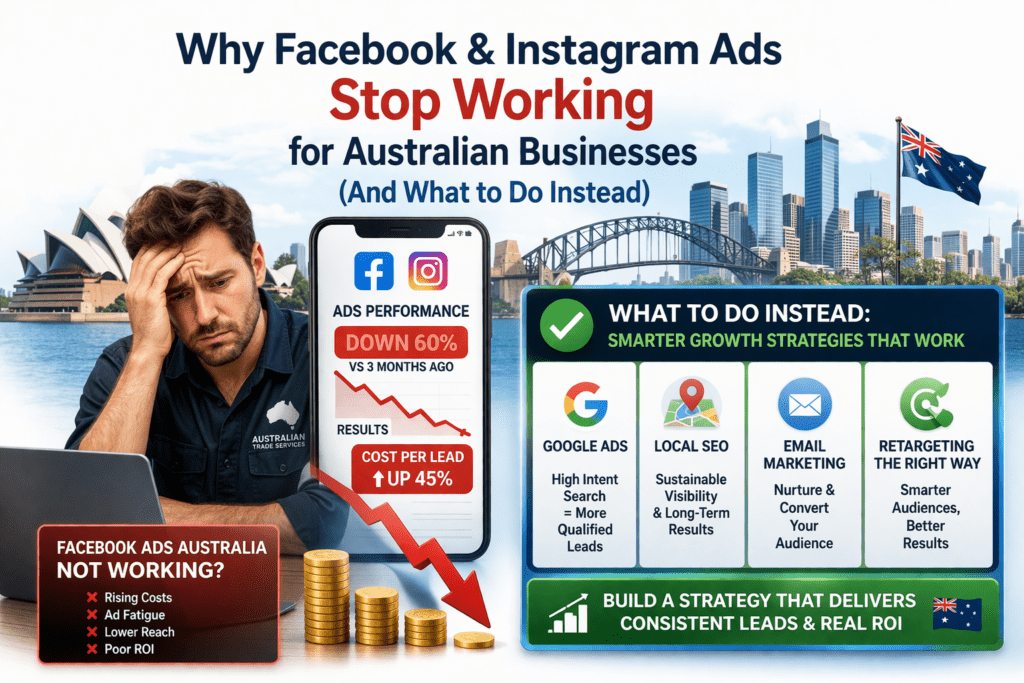
Let’s talk about what’s really happening behind the scenes. When businesses say facebook ads australia not working, they’re usually experiencing a mix of rising costs and declining returns.
Cost per click has increased significantly in many industries. More businesses are advertising than ever before, which means you’re bidding against more competitors for the same audience. This drives prices up while making it harder to stand out.
At the same time, targeting has become less precise. Privacy changes have limited the amount of data available, which means your ads are shown to broader, less defined audiences. That leads to lower conversion rates.
There’s also the issue of trust. Users are more sceptical of ads now. They’ve seen it all—discounts, urgency tactics, flashy creatives—and they’re less likely to click unless something truly stands out.
So it’s not that Facebook ads “stopped working.” It’s that the environment changed, and many strategies didn’t evolve with it.
The Decline of Instagram Ads Strategy Effectiveness
Instagram used to be a goldmine for visually appealing ads. Clean designs, polished images, and catchy captions were enough to grab attention. But now? That style often gets ignored.
Why? Because users have developed ad blindness. They scroll quickly, filtering out anything that looks too promotional. If your ad feels like an ad, it’s already at a disadvantage.
This has forced a shift in instagram ads strategy. The focus is no longer on perfection—it’s on authenticity. Content that feels real, relatable, and native to the platform performs much better than highly produced creatives.
Another factor is saturation. Instagram feeds are crowded, and stories are packed with ads. Standing out requires more than just good design—it requires a deep understanding of your audience and how they consume content.
What Changed in the Advertising Landscape
The drop in performance didn’t happen overnight. It’s the result of several major changes that reshaped how digital advertising works.
Privacy Updates and Tracking Limitations
One of the biggest shifts came from privacy updates. Users now have more control over their data, which means platforms have less information to work with.
For advertisers, this creates a challenge. Tracking conversions becomes less accurate, making it harder to optimise campaigns effectively. You might be getting results—but not seeing them clearly in your data.
This uncertainty leads to poor decision-making. Businesses either cut campaigns too early or scale ones that aren’t actually profitable.
Rising Competition and Ad Costs
Digital advertising is no longer a niche—it’s the norm. Every business, from local shops to large companies, is competing for attention.
This increased competition drives up costs and reduces margins. What used to be a profitable campaign can quickly become unsustainable.
And here’s the key point: you can’t outspend the problem forever. At some point, you need a smarter approach.
The Real Reason Your Ads Stop Converting
When performance drops, most businesses blame the platform. But in reality, the issue often runs deeper. Ads don’t fail in isolation—they fail because the entire system around them isn’t built to convert consistently.
Think about it like this: your ad is just the entry point. What happens after the click matters just as much, if not more. If your offer is unclear, your landing page is weak, or your messaging doesn’t connect, even the best ad won’t save you.
We’ve analysed dozens of campaigns where businesses claimed facebook ads australia not working, but the real issue wasn’t the ads—it was everything behind them. Fix the system, and suddenly performance improves without increasing spend.
Audience Fatigue and Ad Blindness
One of the biggest hidden killers of performance is audience fatigue. If you’re targeting the same group of people repeatedly, they eventually stop paying attention. Your ad frequency increases, engagement drops, and costs rise.
It’s like hearing the same song on repeat—you might like it at first, but eventually, you tune it out.
On platforms like Facebook and Instagram, this happens faster than most people expect. Users scroll quickly, and their brains are trained to ignore anything that looks familiar or overly promotional.
This is where many instagram ads strategy approaches fall short. Businesses reuse the same creatives, tweak a headline, and expect different results. But small changes don’t reset audience perception—you need fresh angles, new messaging, and different formats.
Short-form videos, behind-the-scenes content, and raw, unpolished clips often perform better today because they feel authentic. They blend into the feed instead of interrupting it.
Weak Offers and Poor Funnel Structure
Let’s be direct—if your offer isn’t compelling, no amount of targeting will fix it.
Many ads fail because they ask too much, too soon. They push for a sale without building trust or providing value first. But modern consumers don’t respond well to pressure—they respond to clarity and relevance.
Your funnel needs to guide the customer step by step. Awareness, interest, trust, and then action. Skip any of these stages, and conversions drop.
For example, instead of sending cold traffic directly to a sales page, you might first offer something useful—like a guide, consultation, or simple insight. This warms up the audience and increases the likelihood of conversion later.
It’s not about making the funnel more complex—it’s about making it more aligned with how people actually make decisions.
Why Paid Ads Alone Are No Longer Enough
Relying entirely on paid ads is like building your business on rented land. It works—until it doesn’t.
The moment costs increase or performance drops, your entire system feels unstable. That’s exactly what many Australian businesses are experiencing right now.
The Risk of Platform Dependency
When all your leads come from one platform, you’re vulnerable. Algorithm changes, policy updates, or increased competition can impact your results overnight.
We’ve seen businesses go from profitable to struggling in a matter of weeks—not because they did something wrong, but because the platform environment shifted.
This is why diversification matters. You need multiple channels working together, not a single point of failure.
Short-Term vs Long-Term Marketing Assets
Paid ads are great for short-term results. But they don’t build long-term value on their own.
Once you stop spending, the traffic stops. There’s no lasting asset.
Compare that to strategies like SEO or email marketing. These build over time and continue delivering results even when you’re not actively investing in ads.
The smartest businesses don’t choose one over the other—they combine both. They use ads for speed and organic strategies for stability.
What to Do Instead: Smarter Growth Strategy
So what actually works now?
The answer isn’t abandoning ads—it’s evolving beyond them.
Combining Paid Ads with Local SEO
One of the most effective shifts we’ve seen is combining ads with local SEO, especially Google Maps optimisation.
Here’s why it works: ads bring immediate traffic, while local SEO captures high-intent users who are already searching for your service.
Instead of competing for attention in a crowded feed, you show up when someone is actively looking for what you offer.
This reduces your dependency on ads and improves your overall return on investment.
Building Trust Through Organic Presence
Trust has become the deciding factor in conversions.
People don’t just click—they research. They check reviews, browse your website, and compare options.
If your organic presence is weak, your ads have to work twice as hard.
That’s why investing in content, reviews, and visibility outside of ads is so important. It supports your campaigns and makes every click more valuable.
High-Converting Instagram Ads Strategy That Still Works
Despite the challenges, Instagram ads can still perform—if you adapt your approach.
Creative That Feels Native, Not Salesy
The best-performing ads today don’t look like ads. They look like content.
Think casual videos, real people, simple messaging. משהו that feels natural in the feed.
Highly polished, overly branded creatives often get ignored because they trigger “ad mode” in the user’s mind.
Leveraging User-Generated Content
User-generated content is one of the most powerful tools right now.
When people see real customers using your product or service, it builds instant credibility. It feels authentic because it is.
Encouraging customers to share their experiences—and then using that content in your ads—can significantly improve performance.
Alternative Channels That Drive Better ROI
If your ads are underperforming, it’s time to expand your strategy.
Google Maps and Local Search
We’ve already seen how powerful local search can be. Unlike social media ads, it captures users with clear intent.
They’re not browsing—they’re deciding.
This makes it one of the highest-converting channels available, especially for service-based businesses.
Email and Retention Marketing
Most businesses focus only on getting new customers, but retention is just as important.
Email marketing allows you to stay connected with your audience, build relationships, and generate repeat business—without paying for every interaction.
It’s a simple but highly effective way to stabilise your revenue.
Common Mistakes Businesses Keep Making
Even with all this information, many businesses repeat the same mistakes.
Scaling Too Fast
When a campaign works, the natural reaction is to increase the budget quickly. But scaling too fast can break what was working.
Gradual adjustments are safer and more sustainable.
Ignoring Data and Analytics
Data tells you what’s really happening—but only if you pay attention.
Too many businesses rely on assumptions instead of analysing performance. This leads to poor decisions and wasted budget.
How Kokhan Marketing Company Helps Fix Ad Performance
At Kokhan Marketing Company (https://kokhan-marketing.com/), we’ve worked with businesses facing exactly these challenges—falling performance, rising costs, and frustration with inconsistent results.
Our approach isn’t about chasing trends or quick fixes. We focus on building balanced marketing systems that combine paid ads with long-term strategies like local SEO and conversion optimisation.
Instead of asking, “How do we get more clicks?” we ask, “How do we turn visibility into consistent revenue?”
By aligning your instagram ads strategy with a strong organic presence and smarter funnel design, we help reduce wasted spend and improve overall performance.
Conclusion
If your ads feel like they’ve stopped working, it’s not your imagination.
The landscape has changed. Costs are higher, audiences are more selective, and old strategies don’t deliver the same results.
But this isn’t the end of advertising—it’s a shift.
Businesses that adapt, diversify, and focus on long-term growth will come out ahead. Those that rely on outdated tactics will continue to struggle.
The goal isn’t just to run ads—it’s to build a system that works, even when ads don’t.