Understanding the Dutch Digital Advertising Landscape
High Digital Maturity of NL Audience
If you’re running paid campaigns in the Netherlands, you’re not dealing with beginners. Dutch users are some of the most digitally advanced in Europe, and that changes the game completely when comparing Google Ads vs LinkedIn Ads.
Internet penetration in the Netherlands sits above 95%, and more importantly, people are extremely comfortable researching products and services online before making decisions. They don’t just click and convert—they analyze, compare, and often revisit multiple times. That behavior directly impacts how both platforms perform.
On Google, this means users often search with very specific intent. They already know what they’re looking for, which can lead to higher conversion rates—but also higher competition and rising CPCs.
On LinkedIn, the behavior is different. Users are in a professional mindset, but not necessarily in “buying mode.” They’re scrolling, networking, consuming content. So instead of capturing demand, you’re often creating it.
Another important factor? Trust and skepticism. Dutch audiences are known for being direct and practical. They don’t respond well to exaggerated claims or overly aggressive marketing. This applies to both platforms, but it’s especially critical on LinkedIn, where credibility plays a huge role.
So before even comparing performance metrics, you need to understand this:
The Dutch market rewards relevance, clarity, and honesty over hype.
And whichever platform you choose, that principle will define your results.
B2B Marketing Trends in the Netherlands
B2B marketing in the Netherlands has evolved quickly over the past few years. Traditional outbound methods are losing ground, while data-driven digital strategies are taking over. And this is where the Google Ads vs LinkedIn Ads debate becomes highly relevant.
One noticeable trend is the shift toward full-funnel marketing. Companies are no longer relying on a single platform to generate leads. Instead, they combine channels to guide prospects through the entire journey—from awareness to conversion.
Google Ads typically plays a strong role in the bottom of the funnel, capturing users who are actively searching for solutions. LinkedIn, on the other hand, is often used for top- and mid-funnel activities like brand awareness, thought leadership, and lead nurturing.
Another trend is the increasing focus on lead quality over quantity. Dutch companies are becoming more selective. They’re not just asking, “How many leads did we get?” but “How many of those leads actually turned into customers?”
This shift benefits LinkedIn, where targeting is more precise, but it also raises expectations for Google campaigns to deliver more qualified traffic.
Also worth noting is the growing importance of local relevance. Campaigns that feel generic or imported from other markets tend to underperform. Messaging needs to resonate with Dutch business culture—direct, transparent, and value-driven.
So when comparing Google Ads and LinkedIn Ads in the Netherlands, it’s not just about cost or clicks. It’s about how each platform fits into a broader, more strategic approach to B2B marketing.
Google Ads Overview in NL Market
How Google Ads Works for Lead Generation
Google Ads is often the first platform marketers turn to—and for good reason. It captures existing demand, which makes it incredibly powerful for lead generation in the Netherlands.
Here’s how it works in simple terms: someone searches for a solution, your ad appears, and if it matches their intent, they click and potentially convert. It’s a direct path from problem to solution.
In the Dutch market, this is especially effective because users tend to search with clear intent. Queries are often specific and solution-oriented, which means your ads can align closely with what people actually need.
But there’s a catch—competition. Because Google Ads is so effective, many companies invest heavily in it. This drives up cost per click, particularly in competitive industries like SaaS, finance, and consulting.
Another factor is keyword strategy. Broad keywords can bring in traffic, but not always the right kind. Long-tail keywords, while lower in volume, often deliver better-qualified leads at a lower cost.
Also, Google isn’t just about search anymore. Display, YouTube, and Performance Max campaigns allow you to reach users at different stages of the journey. But for B2B lead generation in the Netherlands, search remains the strongest performer.
When done right, Google Ads can deliver consistent, scalable results. But it requires precision—tight targeting, strong ad copy, and optimized landing pages.
Typical Costs and Performance Benchmarks
Let’s talk numbers—because this is where many decisions are made.
In the Netherlands, Google Ads CPCs can vary widely depending on the industry. For B2B sectors, it’s not uncommon to see clicks ranging from €2 to €10+, and in highly competitive niches, even higher.
Cost per lead (CPL) can range from:
| Industry | Average CPL (NL) |
| SaaS | €80 – €250+ |
| Finance | €100 – €300+ |
| Local Services | €20 – €80 |
These are rough benchmarks, but they give you a sense of what to expect.
What makes Google attractive is its efficiency at scale. Once you find a profitable setup, you can increase budget and generate more leads relatively predictably.
However, rising competition means that maintaining low CPL requires continuous optimization. Keyword refinement, negative keywords, bid strategies, and landing page improvements all play a role.
So while Google Ads can be cost-effective, it’s not “set and forget.” It’s a performance-driven channel that rewards ongoing attention.
LinkedIn Ads Overview in NL Market
Why LinkedIn Is Strong for B2B
If Google is about capturing demand, LinkedIn is about targeting the exact people who make decisions. And in B2B, that’s incredibly valuable.
LinkedIn’s biggest strength lies in its targeting capabilities. You can reach users based on job title, industry, company size, seniority, and more. In a market like the Netherlands, where precision matters, this level of control is a huge advantage.
Another factor is context. People on LinkedIn are in a professional mindset. They’re thinking about work, growth, and business challenges. That makes them more receptive to B2B messaging compared to other social platforms.
LinkedIn is particularly effective for:
- Account-based marketing (ABM)
- High-ticket B2B services
- Niche industries with defined audiences
However, it’s not a quick-win platform. Success requires strong messaging, valuable content, and a clear understanding of your audience’s pain points.
Average Costs and Lead Quality
Let’s address the obvious downside: LinkedIn is expensive.
In the Netherlands, CPCs often range from €5 to €12+, and cost per lead can easily reach €100–€400 or more, depending on the industry.
But here’s the key point—lead quality is usually higher.
Because targeting is so precise, the leads you generate are more likely to match your ideal customer profile. That means better conversion rates down the line, even if the initial CPL is higher.
It’s a classic trade-off:
- Google Ads → Lower CPL, higher volume
- LinkedIn Ads → Higher CPL, better quality
The right choice depends on your goals. If you need volume, Google might win. If you need highly qualified leads, LinkedIn often justifies the cost.
Targeting Capabilities Comparison
Intent-Based vs Profile-Based Targeting
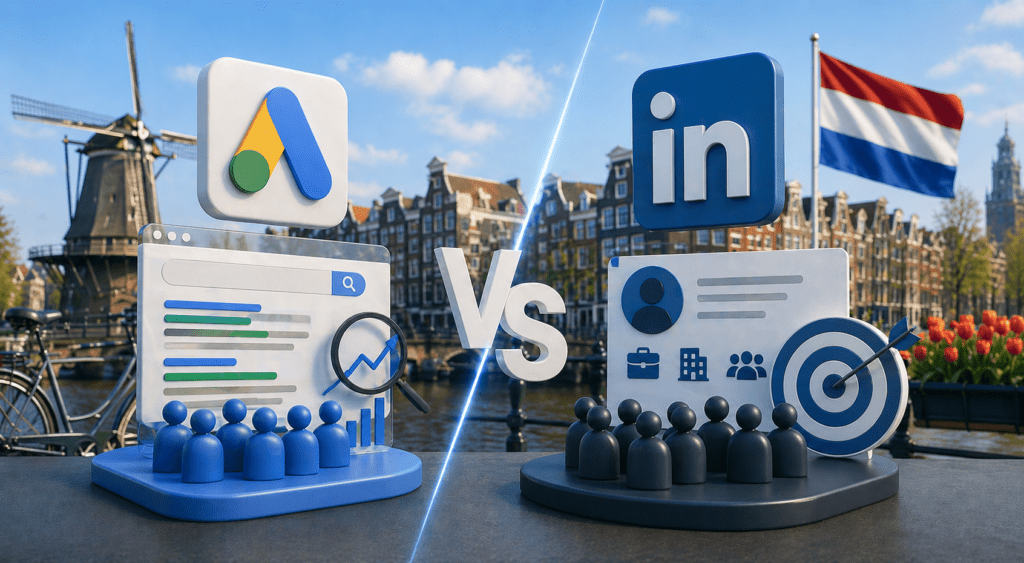
This is where the real difference between Google Ads vs LinkedIn Ads in the Netherlands becomes obvious. You’re not just choosing a platform—you’re choosing how you reach your audience.
Google Ads is built around intent-based targeting. People go to Google because they’re actively looking for something. They type in a query like “best CRM for small business” or “IT support company Netherlands,” and your ad appears if it matches that intent. It’s reactive, but powerful. You’re meeting users exactly when they’re already thinking about a solution.
LinkedIn Ads works completely differently. It’s based on profile targeting. You’re not waiting for someone to search—you’re proactively reaching them based on who they are. Their job title, industry, company size, seniority level—all of that becomes your targeting criteria.
So which one is better? Honestly, neither—they just serve different purposes.
Intent targeting is amazing for capturing existing demand, but it has limitations. You can’t control who is searching. A junior employee, a student, or a decision-maker might all use the same keyword. That can lead to irrelevant clicks and wasted budget.
Profile targeting solves that problem. On LinkedIn, you can ensure your ads are seen only by, say, “Marketing Directors at SaaS companies with 50–200 employees in the Netherlands.” That level of precision is hard to beat.
But here’s the trade-off: those users might not be actively looking for your solution at that moment. So while relevance is high, immediate conversion rates can be lower.
The smartest advertisers in the Dutch market don’t choose between intent and profile—they combine both strategically.
Precision and Audience Control
When it comes to control, LinkedIn clearly takes the lead—but that doesn’t mean Google is weak. It just means they operate differently.
LinkedIn gives you almost surgical precision. You can narrow your audience down to very specific professional segments. This is especially valuable in B2B, where reaching the wrong person can completely derail your campaign performance.
Google, on the other hand, offers control through keywords, audiences, and data signals. You can refine targeting with:
- Exact and phrase match keywords
- Custom intent audiences
- Remarketing lists
- In-market segments
While it’s not as “job-title specific” as LinkedIn, it’s still powerful—especially when combined with strong negative keyword strategies to filter out irrelevant traffic.
In the Netherlands, where audiences are relatively small compared to larger markets, this distinction becomes even more important. Over-targeting on LinkedIn can limit reach too much, while under-targeting on Google can waste budget.
The key is balance. Use LinkedIn when you need precision and control over who sees your ads. Use Google when you want to capture when people are ready to act.
Cost Per Lead Comparison
Why Google Ads Can Be Cheaper
At first glance, Google Ads often looks like the winner in terms of cost per lead. And in many cases, it is.
Because you’re targeting users with clear intent, conversion rates tend to be higher. That means more leads from the same amount of traffic, which naturally lowers CPL.
Also, Google offers more flexibility in managing costs. You can optimize for long-tail keywords, adjust bids, and refine campaigns to find more cost-efficient opportunities. In the Netherlands, where competition can be intense, this flexibility is crucial.
Another advantage is volume. Google simply has more traffic. More searches mean more opportunities to generate leads, which helps maintain a steady flow.
But “cheaper” doesn’t always mean “better.” Lower CPL can sometimes come at the expense of lead quality.
If your targeting isn’t tight, you might generate leads that look good on paper but don’t convert into customers. And when that happens, your real cost per acquisition increases—even if your CPL looks low.
So yes, Google Ads can be cheaper. But only if you manage it carefully and align it with your actual business goals.
Why LinkedIn Leads Are More Expensive but Better
Now let’s flip the perspective.
LinkedIn Ads often have a higher CPL, sometimes significantly higher. But there’s a reason for that—and it’s not just because the platform is expensive.
You’re paying for precision and relevance.
When your ads are shown to decision-makers, senior professionals, or specific industries, the likelihood of generating meaningful conversations increases. These leads might be fewer, but they’re often more valuable.
In the Netherlands, where B2B deals can be high-value and relationship-driven, this matters a lot. A single qualified lead from LinkedIn can sometimes be worth more than multiple leads from other platforms.
Another factor is alignment with account-based marketing (ABM) strategies. LinkedIn allows you to target specific companies or roles, making it easier to focus on high-priority accounts.
So while the upfront cost is higher, the downstream impact—better conversion rates, shorter sales cycles, higher deal sizes—can justify the investment.
The real question isn’t “Which platform is cheaper?”
It’s “Which platform brings leads that actually turn into revenue?”
Conversion Rates and Lead Quality
Volume vs Qualification Trade-Off
This is where things get interesting—and where many marketers get confused.
Google Ads typically delivers higher volume. More clicks, more traffic, more leads. But with that volume comes variability in quality.
LinkedIn, on the other hand, delivers lower volume but higher qualification. Fewer leads, but more aligned with your ideal customer profile.
It’s a classic trade-off:
| Factor | Google Ads | LinkedIn Ads |
| Lead Volume | High | Low–Medium |
| Lead Quality | Medium | High |
| Intent Level | High | Medium |
| Targeting Control | Medium | Very High |
In the Dutch market, where efficiency matters, choosing between volume and quality depends on your business model.
If you have a strong sales team that can qualify leads effectively, Google’s volume might work in your favor. But if your resources are limited and you need highly targeted leads from the start, LinkedIn becomes more attractive.
Sales Cycle Impact
Another key difference is how each platform influences your sales cycle.
Google leads often come in with higher intent, which can shorten the time to conversion. They’ve already identified a need and are actively looking for solutions.
LinkedIn leads, however, might require more nurturing. Since you’re often reaching them earlier in the journey, they need time to move from awareness to decision.
But here’s the twist—LinkedIn can also accelerate trust. Because of the professional context and precise targeting, users may perceive your brand as more credible, which can positively influence long-term conversions.
In the Netherlands, where trust and transparency are critical, this can make a meaningful difference.
So while Google may win on speed, LinkedIn often wins on relationship-building.
Best Use Cases for Each Platform
When to Choose Google Ads
Google Ads is your go-to platform when:
- You want to capture existing demand
- Your audience is actively searching for solutions
- You need consistent lead volume
- You have strong keyword-driven intent
It works especially well for services with clear search behavior—think SaaS tools, consulting, legal services, and local B2B offerings.
When LinkedIn Ads Make More Sense
LinkedIn shines when:
- You need precise B2B targeting
- Your audience is niche or hard to reach
- You’re running ABM campaigns
- You’re building brand awareness in a professional space
It’s ideal for high-ticket services, enterprise solutions, and industries where decision-makers are clearly defined.
Combining Google Ads and LinkedIn Ads
Full-Funnel Strategy for NL Market
The real magic happens when you stop choosing—and start combining.
In the Netherlands, the most effective strategies use both platforms to cover the entire funnel:
- LinkedIn → Awareness and consideration
- Google → Intent capture and conversion
This way, you’re not just waiting for demand—you’re creating it and then capturing it.
Retargeting Across Platforms
Cross-platform retargeting is another powerful tactic. Someone who clicks your LinkedIn ad can later be retargeted on Google Display or YouTube, reinforcing your message and increasing conversion chances.
This creates multiple touchpoints, which is essential in B2B.
Common Mistakes in NL Campaigns
Misallocating Budget Between Platforms
One common mistake is going all-in on one platform without testing the other. This limits your potential and creates blind spots in your strategy.
Ignoring Localization and Messaging
Even the best platform won’t save you if your messaging doesn’t resonate with Dutch audiences. Keep it clear, direct, and honest.
Final Verdict: Which Platform Wins in the Netherlands
Decision Framework for Marketers
There’s no universal winner. The right choice depends on your goals:
- Need volume? → Google Ads
- Need precision? → LinkedIn Ads
- Want both? → Combine strategically
Future Trends in NL Paid Advertising
As privacy changes and competition increases, the gap between platforms may shift. But one thing is clear—data-driven, multi-channel strategies will define success in the Netherlands.
Conclusion
Choosing between Google Ads and LinkedIn Ads in the Netherlands isn’t about picking a winner—it’s about understanding their roles. Each platform excels in different areas, and the best results come from using them together.
When you align platform strengths with your business goals, you stop wasting budget and start building a system that consistently generates high-quality B2B leads.