Understanding the Swiss B2B Market
Why Switzerland Is a High-Cost Market
If you’ve ever tried running B2B marketing campaigns in Switzerland, you’ve probably noticed one thing straight away—it’s expensive. And not just slightly expensive. We’re talking significantly higher cost per lead (CPL) compared to most European markets.
There are a few reasons for this. First, Switzerland has one of the highest GDPs per capita in the world, which means salaries, advertising costs, and operational expenses are all elevated. Whether you’re running Google Ads, LinkedIn campaigns, or SEO initiatives, you’re competing in a premium environment.
Second, the market is relatively small but highly competitive. You’re not just competing with local companies—you’re often up against international players targeting the same high-value audience. That drives up bidding costs, especially for high-intent B2B keywords.
Another factor is audience quality. Swiss businesses tend to be well-established, structured, and selective. Decision-makers are not impulsive. They take their time, evaluate options carefully, and expect a high level of professionalism. That means it often takes more touchpoints—and more investment—to convert a lead.
But here’s the key insight: a high CPL isn’t necessarily a bad thing. In fact, in Switzerland, a higher CPL can still mean better ROI if the lead quality is strong. The real problem isn’t cost—it’s paying too much for leads that don’t convert.
Understanding this distinction is crucial. Your goal isn’t just to lower CPL—it’s to lower it without sacrificing lead quality, and that requires a smarter, more strategic approach.
Buyer Expectations and Decision-Making
Swiss buyers are a different breed altogether. If you’re applying the same lead generation strategies that work in other countries, there’s a good chance they’re falling flat here.
Why? Because Swiss decision-makers value precision, trust, and reliability above all else. They’re not easily swayed by flashy ads or aggressive sales tactics. In fact, those approaches can backfire.
Instead, they expect clear, well-structured information. They want to understand exactly what your solution does, how it benefits them, and why it’s worth the investment. If your messaging is vague or overly promotional, it won’t resonate.
Another important aspect is the multi-language environment. Switzerland has four official languages—German, French, Italian, and Romansh. In practice, most B2B communication happens in German, French, or English. If your campaigns aren’t tailored to the right linguistic audience, you’re likely wasting budget on irrelevant clicks.
There’s also a strong emphasis on reputation. Swiss companies prefer working with partners they trust. That means your brand presence, case studies, and social proof play a massive role in lead generation success.
And let’s not forget the decision-making process. It’s often slow, structured, and involves multiple stakeholders. This makes lead nurturing just as important as lead acquisition.
If you want to reduce CPL without losing quality, you need to align with these expectations—not fight against them.
Why Your Cost Per Lead Is So High
Inefficient Targeting
One of the most common reasons for a high cost per lead in Switzerland is simply targeting the wrong audience. It sounds obvious, but it happens more often than you’d think.
Many campaigns cast too wide a net. They target broad industries, generic job titles, or large geographic areas without refining the audience. The result? You attract clicks from people who were never likely to convert in the first place.
In a high-cost market like Switzerland, this approach is especially risky. Every irrelevant click isn’t just wasted—it’s expensive waste.
Effective targeting means narrowing your focus. Who exactly are you trying to reach? What industries, company sizes, and roles are most likely to benefit from your solution? The more specific you are, the more efficient your campaigns become.
Another issue is ignoring intent. Not all prospects are at the same stage of the buying journey. Targeting someone who’s just browsing with the same message as someone actively looking for a solution is inefficient.
Precision isn’t about limiting opportunities—it’s about maximising relevance. And in Switzerland, relevance is everything.
Over-Reliance on Paid Channels
Paid advertising is powerful, but relying on it too heavily can quickly inflate your CPL.
Platforms like Google Ads and LinkedIn are highly competitive in Switzerland. Cost-per-click (CPC) rates are among the highest in Europe, especially for B2B keywords. If paid channels are your primary source of leads, your costs will naturally remain high.
The problem isn’t paid ads themselves—it’s the lack of balance. Many businesses neglect organic channels like SEO, content marketing, and LinkedIn engagement. These channels may take longer to build, but they can significantly reduce your average cost per lead over time.
Think of it like this: paid ads are like renting traffic, while SEO and content are like owning it. If you only rent, your costs never go down.
A more sustainable approach combines both. Use paid campaigns for quick wins and testing, while investing in organic strategies for long-term efficiency.
Reducing CPL isn’t about cutting spend—it’s about spending smarter.
Improving Targeting Precision
Defining Ideal Customer Profiles (ICP)
If you’re serious about lowering your cost per lead in Switzerland, defining a clear Ideal Customer Profile (ICP) isn’t optional—it’s essential.
An ICP goes beyond basic demographics. It’s a detailed description of the companies that are most likely to become high-value customers. This includes industry, company size, revenue, location, and even specific challenges they face.
Why does this matter? Because the more accurately you define your audience, the less budget you waste on irrelevant prospects.
In Switzerland, where each click can be costly, this level of precision makes a huge difference. Instead of targeting “manufacturing companies”, you might focus on “mid-sized Swiss manufacturing firms with 50–200 employees facing supply chain inefficiencies”.
See the difference? One is broad. The other is actionable.
Your ICP should also evolve over time. Analyse your best customers—what do they have in common? Use that data to refine your targeting continuously.
When your campaigns are aligned with a well-defined ICP, your lead quality improves, and your CPL naturally decreases.
Leveraging Account-Based Marketing
Account-Based Marketing (ABM) is particularly effective in high-value markets like Switzerland. Instead of targeting a wide audience, ABM focuses on a specific list of high-potential companies.
This approach may seem narrower, but it’s far more efficient. You’re not trying to attract anyone—you’re targeting the right ones.
With ABM, your messaging becomes highly personalised. You can tailor content, ads, and outreach to the specific needs of each account. This increases engagement and improves conversion rates.
It also aligns well with Swiss business culture, which values relevance and personalisation. Generic campaigns often get ignored, but targeted, thoughtful outreach stands out.
While ABM may require more upfront effort, it often leads to lower CPL and higher ROI in the long run.
Optimising Paid Advertising Campaigns
Smarter Budget Allocation
Throwing more money at ads won’t fix a high cost per lead in Switzerland—if anything, it can make things worse. The real win comes from how you allocate your budget, not how much you spend. In a premium market like Switzerland, every franc needs to work harder, so precision becomes your best ally.
Start by analysing which channels actually deliver high-quality B2B leads rather than just traffic. It’s tempting to double down on platforms that generate the most clicks, but clicks don’t pay the bills—conversions do. Often, you’ll find that a smaller, more targeted campaign on LinkedIn or Google Search outperforms broader display campaigns that burn through budget quickly.
Another smart move is to shift budget towards bottom-of-funnel campaigns. These target users who already show intent—searching for specific solutions, comparing vendors, or revisiting your site. Yes, these clicks are more expensive, but they convert at a much higher rate, effectively lowering your CPL.
Dayparting and geo-targeting can also make a noticeable difference. Running ads during business hours in key Swiss regions (like Zurich, Geneva, or Basel) ensures your budget isn’t wasted on low-intent traffic. It’s a small tweak, but in a high-cost environment, small efficiencies add up quickly.
Finally, don’t spread your budget too thin. It’s better to dominate a narrow, well-defined segment than to barely appear across a wide audience. Focus brings clarity—and clarity brings results.
Ad Creative and Messaging Improvements
Even the best targeting won’t save a campaign with weak messaging. In Switzerland, where audiences are both discerning and detail-oriented, your ad creatives need to do more than just grab attention—they need to build trust instantly.
Swiss professionals respond well to clear, factual, and benefit-driven messaging. Skip the hype. Instead of saying “revolutionary solution”, explain exactly what problem you solve and how. Specificity beats creativity here.
Headlines should be direct and relevant. Think along the lines of solving a concrete issue: reducing operational costs, improving efficiency, or ensuring compliance. If your ad doesn’t immediately answer “Why should I care?”, it’s likely to be ignored.
Visuals also matter, but not in an over-the-top way. Clean, professional designs tend to perform better than flashy or overly complex graphics. The goal is to look credible, not attention-seeking.
Testing is crucial. Run A/B tests on different headlines, formats, and calls-to-action. Over time, you’ll identify what resonates best with your audience. And in a market where each click is expensive, even a small improvement in click-through rate (CTR) or conversion rate can significantly lower your CPL.
Content Marketing That Converts
High-Intent Content Strategies
If your content isn’t generating leads, it’s probably because it’s attracting the wrong audience—or no real intent at all. In Switzerland, where buyers are selective and research-driven, your content needs to align with high-intent search behaviour.
High-intent content focuses on people who are already looking for solutions. These aren’t casual readers—they’re potential buyers. Think case studies, comparison pages, detailed guides, and solution-focused blog posts.
For example, instead of writing a generic article about “digital transformation”, you might create something like “How Swiss Manufacturing Firms Reduce Costs with Automation”. See the difference? One is broad, the other is specific and actionable.
Another effective approach is creating decision-stage content. This includes ROI calculators, product demos, and implementation guides. These assets help prospects move from consideration to action—and that’s where real leads come from.
It’s also worth updating existing content. Sometimes, improving what you already have—adding new data, refining keywords, or enhancing structure—can deliver better results than starting from scratch.
In short, content should not just inform—it should guide. When done right, it becomes one of the most cost-effective ways to generate high-quality B2B leads in Switzerland.
Localised Content for Swiss Audiences
Switzerland isn’t just one market—it’s a mix of cultures, languages, and regional nuances. If your content doesn’t reflect that, it risks feeling disconnected.
Localisation goes beyond translation. It’s about making your content feel relevant to a Swiss audience. That means using local examples, referencing regional industries, and addressing specific challenges faced by Swiss businesses.
Language plays a big role here. German-speaking regions may respond differently than French-speaking ones. Even if English is widely understood, local-language content often performs better in terms of engagement and trust.
Another key element is credibility. Swiss audiences value accuracy and professionalism. Backing up your content with data, case studies, and real-world examples can significantly improve its impact.
Localised content doesn’t just attract more leads—it attracts the right leads. And that’s what ultimately lowers your CPL.
SEO Strategies for Lower CPL
Targeting High-Intent Keywords
SEO is one of the most effective ways to reduce cost per lead in Switzerland, but only if you’re targeting the right keywords. Going after broad, high-volume terms might bring traffic, but it rarely brings conversions.
High-intent keywords are where the real value lies. These are search terms that indicate a clear need or problem. For example, “B2B CRM software Switzerland” is far more valuable than just “CRM software”.
These keywords may have lower search volume, but they attract users who are closer to making a decision. That means higher conversion rates and, ultimately, a lower CPL.
It’s also important to align keywords with content. Each page should target a specific intent and provide a clear path to conversion. If users can’t quickly find what they’re looking for, they’ll leave—and your efforts go to waste.
SEO isn’t just about ranking—it’s about attracting the right traffic.
Multilingual SEO in Switzerland
One of the unique challenges—and opportunities—of the Swiss market is its multilingual nature. Ignoring this can limit your reach and increase your CPL unnecessarily.
Optimising your website for multiple languages allows you to tap into different segments of the market. German, French, and English are the main players in B2B, and each requires its own keyword strategy.
This doesn’t mean duplicating content word-for-word. Each version should be tailored to the language and cultural context. Even small differences in phrasing can impact search performance.
Technical SEO also matters. Proper hreflang tags, localised URLs, and region-specific targeting ensure that users see the right version of your content.
Multilingual SEO might require more effort upfront, but it pays off by expanding your reach and improving efficiency—helping you generate more leads without increasing spend.
Conversion Rate Optimisation (CRO)
Landing Page Improvements
Driving traffic is only half the equation. If your landing pages aren’t converting, your cost per lead will remain high no matter how good your campaigns are.
A strong landing page should be clear, focused, and aligned with user intent. The headline needs to immediately communicate value. What’s in it for the visitor? Why should they care?
Swiss audiences, in particular, appreciate clarity and structure. Avoid clutter. Use clean layouts, concise text, and logical flow. Make it easy for users to understand your offer and take action.
Social proof can also make a big difference. Testimonials, case studies, and client logos help build trust—especially in a market where reputation matters.
Small improvements—like faster loading times or clearer calls-to-action—can significantly boost conversion rates. And when conversions go up, CPL goes down.
Reducing Friction in Forms
Forms are often the final step in the lead generation process—and also the point where many potential leads drop off.
If your forms are too long or complicated, users may abandon them altogether. In Switzerland, where efficiency is valued, simplicity is key.
Ask only for essential information. You can always collect more details later in the process. The goal is to make it as easy as possible for someone to take that first step.
Trust signals are also important. Clearly explain how the data will be used and ensure compliance with GDPR and Swiss data protection standards.
Even small tweaks—like reducing the number of fields or improving design—can lead to noticeable improvements in conversion rates.
Better Lead Qualification
Filtering Out Low-Quality Leads
Not every lead is worth pursuing. And in a high-cost market like Switzerland, chasing low-quality leads can quickly drain your resources.
Implementing better lead qualification processes helps ensure that your efforts are focused on prospects with real potential. This might involve using forms to capture key information or applying lead scoring based on behaviour.
For example, someone who downloads a pricing guide or requests a demo is likely more valuable than someone who reads a single blog post.
Filtering out low-quality leads doesn’t just save time—it improves your overall marketing efficiency, leading to a lower CPL.
Aligning Sales and Marketing
When sales and marketing are aligned, everything works better. Leads are handled more effectively, feedback loops are stronger, and strategies can be refined continuously.
In Switzerland, where relationships and trust are key, this alignment is especially important. A seamless experience—from first touchpoint to final sale—can make a big difference.
Regular communication, shared goals, and clear definitions of qualified leads help ensure that both teams are working towards the same outcome.
Leveraging LinkedIn for Efficient Lead Generation
Organic vs Paid LinkedIn Strategies
LinkedIn is a powerhouse for B2B lead generation in Switzerland, but relying solely on paid ads can keep your CPL high.
Organic strategies—like sharing insights, engaging with posts, and building a network—can generate leads at a much lower cost. While slower, they create long-term value.
Paid campaigns, on the other hand, offer speed and precision. The best approach combines both—using organic efforts to build trust and paid ads to scale results.
Personal Branding for Trust Building
People trust people more than companies. That’s why personal branding is so effective in B2B.
When leaders and employees share their expertise on LinkedIn, it builds credibility and visibility. In Switzerland, where trust is critical, this can significantly influence buying decisions.
Building a Sustainable Lead Generation System
Data-Driven Optimisation
Reducing CPL isn’t a one-time task—it’s an ongoing process. By analysing data, testing strategies, and refining campaigns, you can continuously improve performance.
Focus on metrics that matter: conversions, lead quality, and ROI—not just clicks or impressions.
Consistency Over Short-Term Wins
Quick wins are great, but long-term success comes from consistency. Building a reliable lead generation system takes time, but it pays off with lower costs and better results.
Conclusion
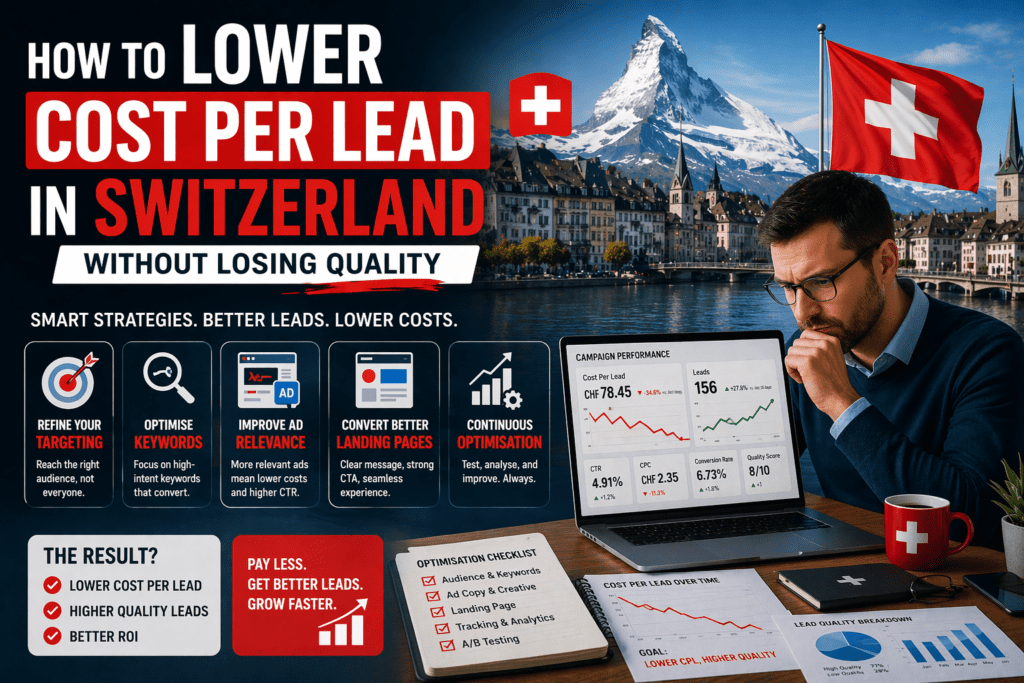
Lowering your cost per lead in Switzerland isn’t about cutting corners—it’s about working smarter. By refining targeting, improving content, optimising conversions, and aligning your strategy with local expectations, you can reduce costs without sacrificing quality.
The Swiss market rewards precision, trust, and relevance. When your marketing reflects these values, better results naturally follow.
FAQs
1. Why is CPL so high in Switzerland?
Due to high competition, premium audience, and elevated advertising costs, Switzerland is naturally a high-CPL market.
2. How can I reduce CPL quickly?
Focus on improving targeting, optimising landing pages, and shifting budget to high-intent campaigns.
3. Is SEO effective in Switzerland?
Yes, especially when targeting high-intent and multilingual keywords.
4. Should I focus on LinkedIn for B2B?
Absolutely. LinkedIn is one of the most effective platforms for Swiss B2B marketing.
5. What’s the biggest mistake in lead generation?
Targeting too broadly and failing to align with the Swiss market’s expectations.