Understanding the Traffic vs Leads Gap
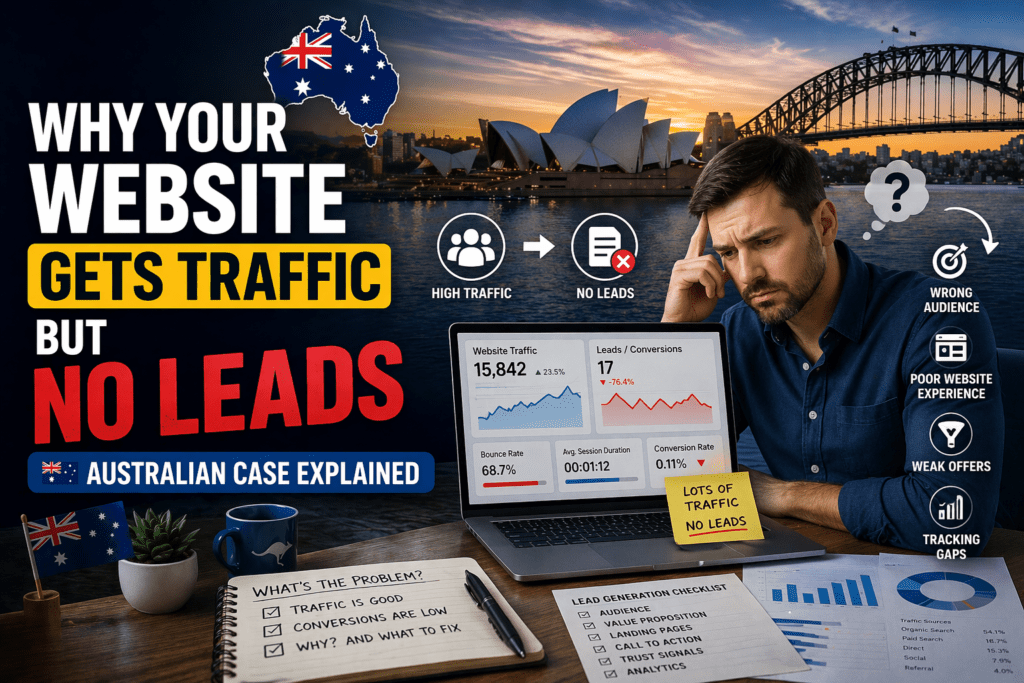
If your website is getting a steady flow of visitors but barely any enquiries, you’re not alone. This is one of the most frustrating problems for Australian businesses investing in SEO, Google Ads, or social media marketing. On paper, everything looks fine—traffic is up, impressions are growing—but your inbox? Still quiet. That gap between traffic and leads is where most businesses lose momentum.
Here’s the thing: website traffic and lead generation are not the same game. Traffic simply means people are visiting your site. Leads mean those visitors are taking action—filling out a form, calling your business, or making a purchase. Without that second step, traffic is just a vanity metric. It looks good in reports, but it doesn’t pay the bills.
In Australia, this issue is even more noticeable because users tend to research more before making decisions. They’ll click through multiple websites, compare options, read reviews, and often leave without taking immediate action. If your website isn’t designed to capture attention and guide users towards conversion, they’ll simply move on to the next option.
Another layer to this problem is intent. Not all traffic is created equal. Someone casually browsing isn’t as valuable as someone actively searching for a solution. If your traffic is coming from low-intent sources, you’ll see numbers go up without any meaningful business results.
Understanding this gap is the first step. Once you realise that traffic without conversion is a broken system, you can start focusing on what actually matters—turning visitors into customers.
What Website Traffic Really Means
Website traffic is often misunderstood. Many business owners see high visitor numbers and assume success is just around the corner. But traffic on its own doesn’t tell you much about quality or intent.
For example, you could have 1,000 visitors a day—but if most of them are landing on your site by accident or out of curiosity, they’re unlikely to convert. This is especially common with broad SEO strategies or poorly targeted Google Ads campaigns in Australia.
Traffic can come from various sources—organic search, paid ads, social media, or referrals. Each source behaves differently. Organic traffic might bring in users who are researching, while paid ads can target users with stronger intent. If you’re not analysing these differences, you’re missing valuable insights.
Another important factor is engagement. Are visitors staying on your site, or are they leaving within seconds? High bounce rates often indicate a mismatch between what users expect and what they find. It’s like inviting someone into a shop that looks nothing like what they saw in the advertisement—they’ll walk straight out.
Understanding your traffic means going beyond numbers. It’s about analysing behaviour, intent, and alignment with your business goals.
Why Traffic Alone Doesn’t Equal Conversions
It’s tempting to think that more traffic will automatically lead to more leads. But in reality, conversion is a completely separate challenge. You can double your traffic and still see no improvement in leads if the underlying issues aren’t addressed.
Conversion depends on several factors—user experience, trust, clarity, and relevance. If any of these are missing, visitors won’t take action. It doesn’t matter how many people land on your site; if they don’t feel confident or motivated, they’ll leave.
In the Australian market, trust plays a particularly big role. Users are cautious and often sceptical of new businesses. If your website doesn’t provide clear proof of credibility—like reviews, testimonials, or local presence—you’ll struggle to convert traffic into leads.
There’s also the issue of friction. If your forms are too long, your navigation is confusing, or your calls-to-action are unclear, users won’t bother. Even small inconveniences can have a big impact on conversion rates.
At its core, this problem isn’t about traffic—it’s about experience. Fix the experience, and the conversions will follow.
Common Reasons Australian Websites Fail to Convert
Let’s get into the real reasons why your site might be underperforming. Most of them aren’t obvious at first glance, which is why they often go unnoticed for months.
Poor User Experience (UX)
User experience is one of the biggest factors affecting conversion rate optimisation Australia. If your website is difficult to use, slow to load, or visually confusing, visitors won’t stick around long enough to convert.
A good UX is about simplicity. Users should be able to find what they’re looking for quickly and easily. If they have to think too much or click through multiple pages, they’re likely to give up.
Mobile optimisation is especially important in Australia, where a large percentage of users browse on their phones. If your site isn’t mobile-friendly, you’re losing a significant portion of potential leads.
Slow Loading Speeds
Speed is a silent killer of conversions. If your website takes more than a few seconds to load, many users will leave before it even appears.
Studies show that even a one-second delay can reduce conversions significantly. In a competitive market, that’s all it takes for users to choose a competitor instead.
Optimising your site speed—through image compression, better hosting, and streamlined design—can have an immediate impact on your website conversion rate Australia.
Weak Value Proposition
When someone lands on your website, they should instantly understand what you offer and why it matters. If your message is unclear or generic, visitors won’t feel compelled to stay.
A strong value proposition answers a simple question: Why should I choose you? If your site doesn’t provide a clear answer, users will look elsewhere.
Lack of Trust Signals
Trust is everything, especially online. Without it, conversions simply won’t happen.
Australian users often look for:
- Reviews and testimonials
- Local business details
- Certifications or guarantees
If these elements are missing, your website may feel unreliable—even if your service is excellent.
Targeting the Wrong Audience
Sometimes the issue isn’t your website at all—it’s who you’re bringing to it. You can have a beautifully designed site, fast loading speeds, and compelling offers, but if the people visiting aren’t the right fit, conversions will always be low. This is one of the most overlooked reasons behind high traffic but no leads in Australia.
A lot of businesses focus heavily on increasing traffic without questioning its quality. They celebrate higher visitor numbers, but those numbers don’t translate into revenue because the audience simply isn’t aligned with the offer. It’s like inviting a crowd to a vegan café where most of them are looking for steak—they might show up, but they won’t stay or buy.
Irrelevant Traffic Sources
Different traffic sources bring different types of users, and not all of them are ready to convert. For example, social media traffic often includes people who are casually browsing rather than actively searching for a solution. On the other hand, Google Ads Australia and organic search tend to attract users with higher intent—people who are already looking for what you offer.
If most of your traffic is coming from low-intent channels, your conversion rate will naturally be lower. That doesn’t mean those channels are useless, but they need to be part of a broader strategy that nurtures users over time rather than expecting immediate results.
Another common issue is poor targeting within paid campaigns. If your audience settings are too broad, your ads will reach people who have no real interest in your product or service. This not only reduces conversions but also wastes your budget.
The key is alignment. Your traffic sources should match your goals. If you want leads, focus on channels that bring in users with strong intent—not just volume.
Misaligned Keywords in SEO and PPC
Keywords are the bridge between what users are searching for and what your website offers. If that bridge is shaky, everything else falls apart. In SEO and PPC campaigns in Australia, targeting the wrong keywords can bring in traffic that looks good on paper but delivers zero results.
For instance, targeting broad or informational keywords like “how to choose a plumber” might attract visitors who are still researching. Meanwhile, someone searching “emergency plumber Sydney” is far more likely to convert. If your strategy leans too heavily towards informational queries, you’ll see traffic without leads.
There’s also the issue of intent mismatch. If your ad or content promises one thing but delivers another, users will leave immediately. This increases bounce rates and reduces trust, making conversions even less likely.
Regular keyword audits are essential. By analysing which keywords drive actual conversions—not just clicks—you can refine your strategy and focus on what truly works in the Australian search market.
Conversion Funnel Problems
Think of your website as a journey. Visitors arrive at the starting point, but if the path isn’t clear or easy to follow, they’ll never reach the destination—that is, becoming a lead or customer. This journey is your conversion funnel, and when it’s broken, results suffer.
Broken Customer Journey
A smooth customer journey guides users from interest to action without confusion. But many websites unintentionally create friction at every step. Maybe the navigation is unclear, the messaging is inconsistent, or the next step isn’t obvious.
For example, a user might land on your homepage, browse your services, and then… what? If there’s no clear direction—no strong call-to-action or logical next step—they’ll likely leave. It’s not because they’re not interested; it’s because they don’t know what to do next.
In Australia, where users tend to compare multiple options, this becomes even more critical. If your site doesn’t make the process easy, they’ll simply move on to a competitor that does.
Mapping out your funnel can help identify gaps. From the first click to the final conversion, every step should feel intuitive and purposeful.
Too Many or Too Few Calls-to-Action
Calls-to-action (CTAs) are where conversions actually happen, but getting them right is trickier than it sounds. Too many CTAs can overwhelm users, making it hard to decide what to do. Too few, and users might not take any action at all.
It’s about balance. Each page should have a clear primary goal—whether that’s filling out a form, booking a call, or making a purchase. Supporting CTAs can exist, but they shouldn’t distract from the main objective.
Clarity is just as important as placement. Instead of vague phrases like “Learn More,” use action-driven language like “Get a Free Quote” or “Book Your Consultation Today.” These make it obvious what the user will get and why it matters.
Content That Doesn’t Sell
Content plays a huge role in converting visitors into leads, but not all content is created with conversion in mind. Many websites focus heavily on attracting traffic through blogs and articles, but fail to guide readers towards taking action.
Informational vs Commercial Content
There’s nothing wrong with informational content—it’s a key part of SEO Australia strategies. But if your site is filled only with educational material, you might attract readers who are curious but not ready to buy.
The trick is to balance informational and commercial content. Informational pages bring users in, while commercial pages convert them. Without that second layer, your traffic won’t translate into leads.
For example, a blog post about “how to improve home insulation” can attract readers, but it should also guide them towards your services. This could be through internal links, clear CTAs, or relevant offers.
Lack of Local Relevance in Australia
Australian users respond strongly to local context. If your website feels generic or doesn’t reflect the local market, it can create a disconnect.
Simple details—like mentioning cities, using local terminology, or showcasing Australian case studies—can make a big difference. It reassures users that you understand their needs and operate within their environment.
Local relevance also improves your visibility in local SEO Australia, helping you attract more qualified traffic in the first place.
How to Fix Low Conversion Rates
Now for the important part—fixing the problem. Turning traffic into leads isn’t about one big change; it’s about improving multiple elements that work together.
Improve Website UX and Speed
Start with the basics. Make sure your website is fast, mobile-friendly, and easy to navigate. These aren’t just technical details—they directly impact how users interact with your site.
Simplify your design, reduce clutter, and ensure key information is easy to find. A smooth experience keeps users engaged and increases the likelihood of conversion.
Optimise for Conversion Rate (CRO)
Conversion Rate Optimisation (CRO) is all about making your existing traffic more effective. Instead of focusing solely on attracting more visitors, you improve how well your site converts the ones you already have.
This might involve testing different layouts, headlines, or CTAs. Even small changes can lead to noticeable improvements in your website conversion rate Australia.
Use Strong Offers and CTAs
Sometimes, the issue isn’t your traffic or your website—it’s your offer. If there’s no compelling reason to take action, users won’t convert.
Consider adding incentives like free consultations, discounts, or downloadable resources. Pair these with clear, action-oriented CTAs that make the next step obvious and appealing.
Advanced Strategies to Turn Traffic into Leads
Once the fundamentals are in place, you can start layering in more advanced tactics to maximise results.
Retargeting Campaigns
Not every visitor will convert on their first visit—and that’s perfectly normal. Retargeting allows you to reconnect with those users through ads, reminding them of your offer and bringing them back to your site.
This is particularly effective in Australia, where users often take longer to make decisions. Retargeting keeps your brand visible throughout that process.
Personalisation and Localisation
Personalisation takes your strategy to the next level. By tailoring content and offers based on user behaviour or location, you create a more relevant experience.
For example, showing different messaging to users in Sydney versus Perth can improve engagement and conversions. It’s about making your website feel less generic and more tailored to each visitor.
Conclusion
If your website is getting traffic but no leads, the problem isn’t random—it’s structural. Whether it’s poor targeting, weak messaging, or a broken conversion funnel, there’s always a reason behind the gap.
The good news? Every one of these issues can be fixed. By focusing on user experience, aligning your traffic with intent, and optimising for conversions, you can turn your website into a lead-generating machine.
FAQs
- Why is my website getting traffic but no enquiries?
This usually happens due to poor targeting, weak offers, or a bad user experience that prevents visitors from taking action. - What is a good conversion rate in Australia?
It varies by industry, but most websites aim for 2% to 5%. Higher rates are possible with strong optimisation. - How can I improve my website conversion rate?
Focus on UX, clear messaging, strong CTAs, and testing different elements through CRO strategies. - Does SEO bring leads or just traffic?
SEO can bring both, but only if your content and website are optimised for conversions—not just visibility. - Should I focus more on traffic or conversions?
Both matter, but conversions should be the priority. Traffic without conversions doesn’t generate revenue.