The Promise of LinkedIn Marketing in the Netherlands
Why Dutch Companies Invest in LinkedIn
If you ask almost any B2B company in the Netherlands where they put their marketing budget, chances are LinkedIn marketing will be somewhere near the top of the list. And on paper, it makes perfect sense. LinkedIn is packed with professionals, decision-makers, and niche audiences that are otherwise difficult to reach. It feels like the ideal playground for lead generation, brand awareness, and thought leadership—especially in a country with such a strong business ecosystem like the Netherlands.
Dutch businesses are particularly drawn to LinkedIn because of its professional tone and its reputation as a platform for serious networking. Compared to platforms like Instagram or TikTok, LinkedIn feels safer, more predictable, and aligned with corporate identity. For industries like finance, logistics, SaaS, and consulting—key pillars of the Dutch economy—it seems like a no-brainer.
There’s also the influence of trends. When competitors start investing heavily in LinkedIn ads or content, others tend to follow. No one wants to feel like they’re missing out. Add to that the promises made by agencies and SaaS tools—claims of scalable lead generation, precise targeting, and measurable ROI—and it’s easy to see why expectations skyrocket.
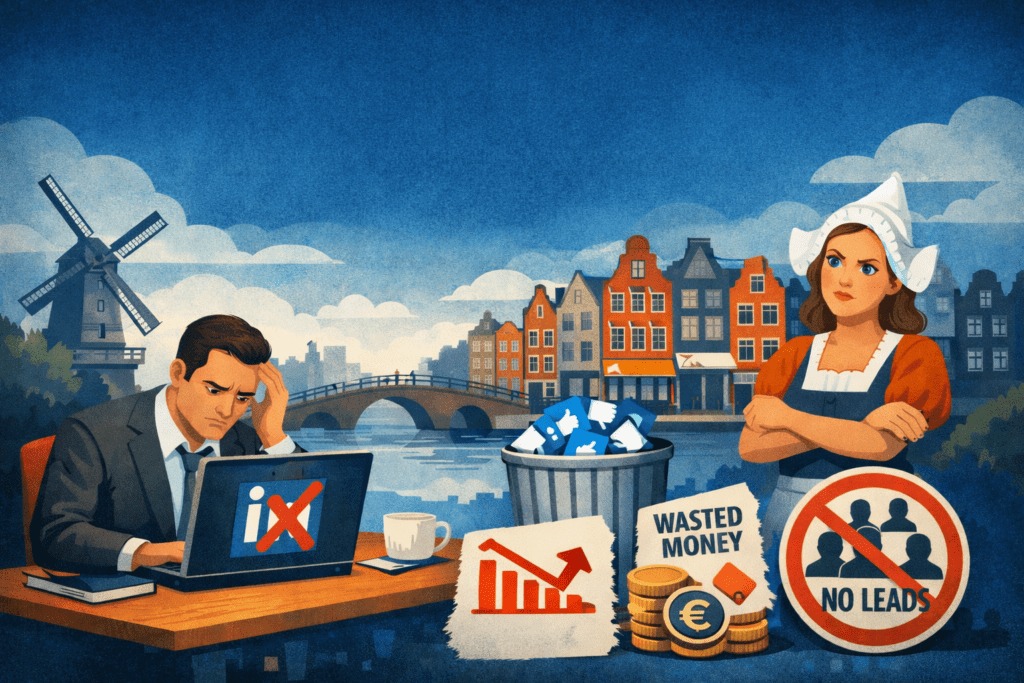
But here’s the catch: while LinkedIn marketing in the Netherlands looks brilliant in theory, the execution often falls flat. Businesses expect quick wins, steady streams of qualified leads, and high engagement. Instead, they get low interaction, expensive clicks, and content that quietly disappears into the void. That gap between expectation and reality is where most Dutch companies begin to feel that LinkedIn “just doesn’t work.”
And the truth is, it’s not the platform that’s broken—it’s how it’s being used.
The Expected ROI vs Reality
Let’s talk about the elephant in the room: return on investment. Many Dutch businesses go into LinkedIn marketing expecting a clear and measurable payoff. They assume that if they invest €1,000 into ads or content creation, they’ll see a predictable number of leads or conversions in return. After all, LinkedIn positions itself as a premium platform with advanced targeting capabilities—so the logic seems sound.
In reality, though, the numbers often tell a different story. Cost per lead on LinkedIn in the Netherlands can be significantly higher than on other platforms, sometimes reaching €50 to €150 or more depending on the industry. For small and medium-sized businesses, that’s a serious investment with no guaranteed outcome. And when those leads don’t convert, frustration builds quickly.
Another common issue is the length of the B2B sales cycle. Dutch businesses, especially in sectors like tech or consultancy, often deal with long decision-making processes. LinkedIn might generate awareness, but that doesn’t immediately translate into revenue. Without a proper nurturing strategy, those leads simply go cold.
There’s also a misunderstanding of what LinkedIn is actually good at. It’s not always a direct-response platform. It’s more about building trust, authority, and relationships over time. Many companies skip that part entirely and jump straight into selling. The result? Audiences tune out, engagement drops, and campaigns underperform.
To make matters worse, businesses often rely on vanity metrics like impressions or likes to justify their efforts. But those numbers rarely correlate with real business outcomes. A post might get thousands of views, yet bring in zero leads.
So when Dutch companies say LinkedIn marketing doesn’t work, what they often mean is this: it didn’t deliver fast, tangible results in the way they expected. And that mismatch in expectations is one of the biggest reasons for disappointment.
Continued in next response…
yes
Misunderstanding the Dutch Audience
Cultural Communication Differences
Here’s where things start to get a bit more nuanced—and honestly, this is one of the biggest reasons LinkedIn marketing fails for Dutch businesses. It’s not just about strategy or budget. It’s about culture. If you’ve ever worked with Dutch clients or teams, you’ll know that communication in the Netherlands is famously direct, honest, and no-nonsense. People value clarity over fluff and substance over style.
Now compare that to the typical tone of LinkedIn content. A lot of it is polished, corporate, and, let’s be real, sometimes a bit exaggerated. Posts are filled with buzzwords like “innovative solutions”, “cutting-edge strategies”, and “game-changing results”. While that might work in other markets, Dutch audiences often see right through it. Instead of building trust, it creates scepticism.
Dutch professionals tend to appreciate straightforward messaging. They want to know exactly what you do, how it helps, and why it matters—without all the marketing fluff. If your content feels overly salesy or vague, it’s likely to be ignored. And on a platform like LinkedIn, where attention is already limited, being ignored is the worst outcome.
There’s also a cultural preference for modesty. In some countries, bold self-promotion is expected. In the Netherlands, it can come across as arrogant or insincere. That creates a tricky balance for marketers. Push too hard, and you lose credibility. Play it too safe, and you disappear into the background.
Another layer to this is humour and tone. Dutch communication often includes subtle humour or a slightly informal edge, even in professional settings. Content that feels too stiff or overly corporate simply doesn’t resonate. People want to engage with real humans, not faceless brands.
So when businesses apply generic LinkedIn marketing strategies without adapting to local communication styles, they miss the mark. It’s not that the audience isn’t interested—it’s that the message doesn’t feel authentic or relevant.
Directness vs Corporate Messaging
Let’s dig a bit deeper into this clash between direct Dutch communication and traditional corporate messaging. Imagine scrolling through LinkedIn and seeing a post that says:
“We are thrilled to announce our innovative, industry-leading solution designed to revolutionise your business operations.”
Now imagine how a typical Dutch professional might interpret that. The reaction is often something like: “Alright, but what does it actually do?” That gap between what’s said and what’s meant is where engagement gets lost.
Dutch audiences tend to prefer clear, specific, and honest communication. They’re not easily swayed by grand claims or vague promises. In fact, those can have the opposite effect, making your brand seem less trustworthy. This is particularly important in B2B marketing, where decisions are based on logic, evidence, and long-term value.
The problem is that many companies rely on global marketing templates that don’t translate well locally. They use the same tone, the same messaging frameworks, and the same content formats across different markets. But what works in the US or UK doesn’t always land in the Netherlands.
There’s also the issue of overcomplicating messages. Corporate LinkedIn posts often try to sound smart by using complex language or industry jargon. But in doing so, they lose clarity. Dutch professionals generally prefer simplicity. If your message isn’t immediately understandable, they won’t spend time decoding it—they’ll just scroll past.
Another key factor is trust. In the Netherlands, trust is built through transparency and consistency, not through polished branding alone. People want to see real insights, honest opinions, and practical value. That’s why content that shares lessons learned, mistakes made, or behind-the-scenes perspectives often performs better than perfectly curated posts.
In short, if your LinkedIn content sounds like it’s trying too hard, it probably is. And for Dutch audiences, that’s a deal-breaker.
Poor Content Strategy and Execution
Overly Corporate and Generic Content
One of the most common pitfalls in LinkedIn marketing in the Netherlands is content that feels like it could have been written by anyone, for anyone. You’ve seen it before—posts that are technically correct but completely forgettable. They tick all the boxes but spark zero interest.
This kind of content usually comes from a place of playing it safe. Companies don’t want to offend, don’t want to take risks, and don’t want to deviate from their brand guidelines. So they end up producing posts that are bland, generic, and overly polished. The irony? In trying to appeal to everyone, they end up connecting with no one.
Dutch audiences, in particular, are quick to disengage from content that lacks authenticity. They value original thinking and practical insights. If your post doesn’t offer something new or useful, it simply won’t hold their attention. And on a platform where users are bombarded with content daily, standing out is essential.
Another issue is the overuse of corporate storytelling frameworks that feel forced or unnatural. Not every post needs to follow a dramatic arc or end with a motivational takeaway. Sometimes, a simple, honest observation or a clear piece of advice is far more effective.
There’s also a tendency to focus too much on the company rather than the audience. Posts that constantly talk about “our services,” “our achievements,” or “our team” quickly become repetitive. People aren’t on LinkedIn to read advertisements—they’re there to learn, connect, and gain insights.
The result of all this? Low engagement, minimal shares, and a growing sense that LinkedIn just isn’t delivering results. But again, the issue isn’t the platform—it’s the approach.
Lack of Storytelling and Personality
If overly corporate content is one extreme, then a lack of personality is the other—and both are equally damaging. One of the biggest missed opportunities in LinkedIn marketing is failing to sound human. And yes, that might sound obvious, but you’d be surprised how many brands still struggle with it.
Think about the content you actually engage with on LinkedIn. Chances are, it’s written by individuals, not companies. It has a voice, a perspective, maybe even a bit of humour. It feels real. That’s what draws people in.
Now compare that to most company posts. They often sound like they’ve been approved by five different departments, stripped of any personality, and polished to the point of being unrecognisable. There’s no emotion, no opinion, no spark.
For Dutch businesses, this is particularly problematic because authenticity is highly valued. People want to know who they’re dealing with. They want to see the humans behind the brand. Without that, it’s hard to build trust or connection.
Storytelling doesn’t have to be complicated. It can be as simple as sharing a client experience, a lesson learned, or a challenge overcome. The key is to make it relatable and genuine. When done right, storytelling can transform your LinkedIn presence from a static feed into a dynamic conversation.
Another important aspect is consistency in tone. If your brand voice changes from post to post, it becomes difficult for your audience to recognise or remember you. Developing a clear, consistent voice helps build familiarity—and familiarity builds trust.
In the end, people don’t engage with logos. They engage with people. And if your content doesn’t reflect that, it’s always going to struggle.
Inconsistent Posting Habits
Let’s be honest—consistency is where many LinkedIn strategies quietly fall apart. It’s easy to start strong, posting regularly for a few weeks, maybe even a couple of months. But then other priorities take over, and suddenly your company page hasn’t posted anything in weeks.
This stop-and-start approach sends mixed signals to both your audience and the LinkedIn algorithm. From the platform’s perspective, inconsistent activity means less visibility. Your content is less likely to be shown, and your reach gradually declines. It’s a bit like trying to build momentum while constantly hitting the brakes.
From the audience’s point of view, inconsistency makes your brand feel unreliable or disengaged. If someone checks your page and sees outdated content, it doesn’t create a strong impression. In fact, it can raise questions about how active or relevant your business really is.
Consistency doesn’t mean posting every day. In fact, for many Dutch businesses, that would be unrealistic and unnecessary. What matters is having a sustainable rhythm—whether that’s once a week or twice a month—and sticking to it.
Planning plays a big role here. Without a clear content calendar or strategy, it’s easy to run out of ideas or lose direction. That’s when posting becomes reactive rather than intentional, and the quality often suffers.
Another factor is resource allocation. Many companies underestimate the time and effort required for effective LinkedIn marketing. It’s not just about writing posts—it’s about research, engagement, analysis, and optimisation. Without proper investment, consistency becomes difficult to maintain.
At the end of the day, LinkedIn rewards those who show up regularly and provide value. If you’re only appearing occasionally, you’re unlikely to see meaningful results.
Continued in next response…
yes
Targeting the Wrong Audience
Weak Buyer Persona Definition
One of the quieter but more damaging mistakes in LinkedIn marketing for Dutch businesses is not truly understanding who they’re trying to reach. On the surface, it often looks like companies have their targeting sorted—they select industries, job titles, company sizes, and locations. But when you dig deeper, the buyer personas are often vague, outdated, or based on assumptions rather than real data.
Here’s the issue: LinkedIn’s targeting tools are only as effective as the strategy behind them. If your definition of your ideal customer is something like “marketing managers in tech companies”, that’s far too broad to produce meaningful results. You’re essentially speaking to thousands of people with completely different needs, priorities, and challenges.
In the Dutch market, this becomes even more critical because businesses tend to operate in highly specialised niches. A logistics company in Rotterdam doesn’t think the same way as a SaaS startup in Amsterdam. Their buying triggers, decision-making processes, and pain points are entirely different. Yet many campaigns treat them as interchangeable.
Another common issue is focusing on job titles rather than problems. Just because someone is a “Head of Operations” doesn’t mean they’re actively looking for your solution. Without understanding their current challenges, your messaging will feel irrelevant, no matter how well-targeted the ad appears on paper.
There’s also a tendency to overlook the multiple stakeholders involved in B2B decisions. In the Netherlands, decision-making is often collaborative. That means your content needs to resonate with more than one type of persona—end users, managers, and executives. If you’re only speaking to one layer, you’re missing a big part of the picture.
The result? Campaigns that generate clicks but not conversions. Engagement without intent. Visibility without impact.
To fix this, businesses need to invest time in building detailed, realistic buyer personas based on actual customer insights. That means talking to clients, analysing past deals, and identifying patterns. It’s less about demographics and more about understanding motivations, objections, and decision criteria.
When you truly know who you’re talking to, everything else—messaging, content, targeting—starts to fall into place.
Over-Reliance on Broad Targeting
Even when Dutch businesses have a decent idea of their audience, they often fall into the trap of going too broad. It’s understandable—LinkedIn campaigns can feel restrictive if you narrow things down too much. There’s always that fear of missing out on potential leads.
But in practice, broad targeting tends to dilute your message and waste your budget. When your audience is too wide, your content has to appeal to too many different people. And as we’ve already touched on, trying to speak to everyone usually means resonating with no one.
This is especially problematic given the high cost of LinkedIn ads. When you’re paying premium prices per click or impression, every bit of inefficiency adds up quickly. Showing your ads to people who are only vaguely relevant isn’t just ineffective—it’s expensive.
Another issue is that broad targeting often leads to misleading performance metrics. You might see a decent number of impressions or even clicks, but those interactions don’t translate into meaningful business outcomes. It creates a false sense of success, which can keep ineffective campaigns running longer than they should.
Dutch audiences, being generally pragmatic and results-oriented, are less likely to engage with content that doesn’t feel directly relevant to them. If your message doesn’t immediately connect with their situation, they’ll simply move on.
A more effective approach is to narrow your focus and create highly tailored campaigns for specific segments. Yes, this requires more effort—more content variations, more testing, more analysis. But the payoff is significantly better alignment between your message and your audience.
Think of it like this: would you rather have 1,000 people mildly interested in your offer, or 100 people who genuinely need it? In most cases, the latter is far more valuable.
Overestimating Organic Reach
LinkedIn Algorithm Realities
There’s a common belief among Dutch businesses that if they just post regularly on LinkedIn, their content will naturally reach a wide audience. It sounds logical—after all, you have followers, connections, and a network. Surely your posts will show up in their feeds, right?
Not quite.
The reality is that the LinkedIn algorithm is far more selective than many people realise. Organic reach has been declining steadily, and not every post gets equal visibility. In fact, only a small percentage of your audience is likely to see any given post unless it quickly gains traction.
The algorithm prioritises content that generates early engagement—likes, comments, and shares within the first hour or two. If your post doesn’t perform well initially, its reach drops off sharply. That means even well-written, valuable content can go unnoticed if it doesn’t get that initial boost.
For Dutch businesses, this can be particularly frustrating because the audience is often more reserved when it comes to engagement. People might read your post and find it useful, but they won’t necessarily like or comment on it. And from the algorithm’s perspective, that silence looks like disinterest.
Another factor is the type of content you’re posting. LinkedIn tends to favour native content—posts that keep users on the platform—over external links. If your strategy relies heavily on driving traffic to your website, your reach may be limited from the start.
There’s also increased competition. More businesses are investing in LinkedIn, which means more content is being published every day. Standing out in that crowded feed requires not just quality, but also timing, relevance, and sometimes a bit of luck.
Understanding these algorithm dynamics is crucial. Without that awareness, it’s easy to misinterpret low reach as a failure of the platform, rather than a signal to adjust your strategy.
The Decline of Organic Visibility
If LinkedIn once felt like a goldmine for organic reach, those days are largely behind us. Over the past few years, the platform has shifted towards a more pay-to-play model, similar to what we’ve seen on Facebook and Instagram.
For Dutch businesses, this shift can be a bit of a shock. Many started using LinkedIn when organic reach was relatively high and results came more easily. But as the platform has matured—and as more companies have joined—the competition for attention has intensified.
Recent data suggests that organic reach on LinkedIn company pages can be as low as 2% to 5% of followers. That means if you have 1,000 followers, only a small fraction will actually see your posts without paid promotion. It’s not exactly encouraging, especially if you’ve invested time and effort into building that audience.
This decline forces businesses to rethink their approach. Relying solely on organic content is no longer enough. You need a combination of organic and paid strategies, working together to amplify your message.
However, simply throwing money at ads isn’t the solution either. Without a strong foundation—clear messaging, relevant content, and proper targeting—paid campaigns will struggle just as much as organic ones.
Another important consideration is engagement quality. It’s not just about reaching more people; it’s about reaching the right people and prompting meaningful interaction. A smaller, highly engaged audience is often more valuable than a large, passive one.
So while organic visibility may be declining, LinkedIn is still a powerful platform—if you adapt to how it actually works today.
Lack of Localisation in Campaigns
English vs Dutch Content Strategy
One of the more subtle mistakes in LinkedIn marketing in the Netherlands is the assumption that English works just as well as Dutch for all audiences. And to be fair, the Netherlands is known for its high level of English proficiency. Many professionals are perfectly comfortable reading and communicating in English.
But comfort doesn’t always equal preference.
When it comes to marketing, language plays a huge role in connection and trust. Content in Dutch often feels more personal, more relevant, and easier to engage with—especially for local businesses or industries that operate primarily within the country.
Using English can sometimes create a sense of distance. It may feel more formal or less relatable, particularly if the content is already quite corporate in tone. For Dutch audiences who value authenticity and clarity, that can be a barrier.
That said, it’s not a simple either-or decision. In some sectors—like tech or international trade—English might be the more appropriate choice. The key is to align your language with your target audience and business goals.
Another factor to consider is nuance. Even if your audience understands English perfectly, subtle cultural references or phrasing might not land as intended. Writing in Dutch allows you to tap into local expressions, humour, and context that make your content feel more natural.
The best approach is often a hybrid strategy. Test both languages, analyse performance, and see what resonates with your audience. In some cases, you might even use both—English for broader reach and Dutch for deeper engagement.
Ignoring this aspect of localisation can limit the effectiveness of your campaigns, even if everything else is done right.
Ignoring Regional Business Nuances
Beyond language, there’s another layer of localisation that many Dutch businesses overlook: regional differences within the Netherlands itself. It’s easy to think of the country as one uniform market, but in reality, there are distinct business cultures and dynamics across different regions.
For example, companies in Amsterdam may be more internationally oriented and open to innovation, while businesses in other regions might prioritise stability, long-term relationships, and practical solutions. These differences can influence how your message is received.
If your LinkedIn strategy doesn’t take these nuances into account, your content may feel slightly off—like it’s not quite speaking the same language as your audience, even if it’s technically correct.
There’s also the issue of industry clusters. Certain regions in the Netherlands are known for specific sectors, such as logistics in Rotterdam or agriculture in Wageningen. Tailoring your content to reflect these local strengths can make it far more relevant and impactful.
Another overlooked aspect is network dynamics. Dutch business culture often relies heavily on relationships and trust built over time. Generic, one-size-fits-all campaigns don’t tap into these networks effectively. More personalised, locally aware approaches tend to perform better.
Taking the time to understand these regional and cultural nuances doesn’t just improve your LinkedIn marketing—it helps you build stronger, more meaningful connections with your audience.
Weak Personal Branding from Leadership
Company Pages vs Personal Profiles
Here’s a hard truth that many Dutch businesses don’t want to hear: company pages on LinkedIn rarely perform as well as personal profiles. And yet, most marketing strategies still revolve almost entirely around the company page. It feels logical—after all, it represents the brand. But in practice, it’s often the least engaging part of your presence.
Think about how people actually use LinkedIn. They connect with individuals, not logos. They follow people whose opinions they respect, whose insights they find useful, and whose voices feel authentic. When a company page publishes content, it often lacks that personal touch. It feels distant, even when the content itself is well-written.
In the Netherlands, where trust and authenticity play a huge role in business relationships, this gap becomes even more significant. People want to know who they’re dealing with. They want to see the faces behind the brand, understand their thinking, and get a sense of their شخصیت (personality). A company page alone can’t provide that.
On the other hand, when leaders—founders, CEOs, directors—actively share content from their personal profiles, the dynamic changes completely. Engagement tends to be higher, conversations feel more natural, and the content reaches a wider audience thanks to LinkedIn’s algorithm favouring personal interactions.
Another advantage is flexibility. Individuals can express opinions, share experiences, and even show vulnerability in ways that company pages simply can’t. That kind of content resonates strongly with Dutch audiences, who appreciate honesty and real-world insight over polished messaging.
That doesn’t mean company pages are useless—they still play an important role in credibility and brand presence. But relying on them as your primary LinkedIn strategy is a mistake. The real opportunity lies in empowering your team, especially leadership, to become active voices in your industry.
When people trust the individuals behind a business, they’re far more likely to trust the business itself.
The Trust Factor in Dutch B2B
Trust isn’t just a nice-to-have in the Dutch B2B landscape—it’s the foundation of almost every successful business relationship. And this is where LinkedIn marketing often falls short, not because it can’t build trust, but because many businesses approach it in the wrong way.
Dutch professionals are generally cautious when it comes to new vendors or partners. They don’t make decisions based on flashy ads or bold claims. Instead, they look for consistency, credibility, and proven expertise over time. This is where personal branding becomes incredibly powerful.
When leaders regularly share insights, comment on industry trends, and engage in meaningful discussions, they start to build a reputation. Not overnight, but gradually. And that reputation carries weight. By the time a potential client considers reaching out, there’s already a level of familiarity and trust in place.
Compare that to a typical LinkedIn ad campaign. It might generate awareness, but it rarely builds the same depth of trust. Without that foundation, even the most well-targeted campaigns can struggle to convert.
Another important aspect is social proof. In the Netherlands, recommendations, testimonials, and peer validation are highly influential. When individuals engage with your content—commenting, sharing, endorsing—it signals credibility to others in the network.
There’s also the matter of transparency. Dutch audiences appreciate when businesses are open about their processes, challenges, and even limitations. Overly polished content can sometimes create suspicion, as if something is being hidden.
Building trust on LinkedIn isn’t about perfection. It’s about showing up consistently, providing value, and being genuine in your communication. And more often than not, that’s best done through people, not pages.
Budget Misallocation and Ad Fatigue
Inefficient LinkedIn Ad Spend
Let’s talk about money—because for many Dutch businesses, this is where frustration peaks. LinkedIn advertising is known for being expensive, and while that cost can be justified with the right strategy, it often isn’t.
One of the biggest issues is budget misallocation. Companies invest heavily in ads without first ensuring that their messaging, targeting, and content are properly optimised. It’s a bit like pouring water into a leaky bucket. No matter how much you spend, the results won’t improve if the fundamentals aren’t solid.
Another common mistake is jumping straight into lead generation campaigns without warming up the audience. Dutch professionals, as we’ve discussed, value trust and familiarity. If they’ve never heard of your brand before, they’re unlikely to hand over their contact details just because they saw an ad.
There’s also a tendency to rely too heavily on a single campaign or format. Running the same ad repeatedly without variation leads to diminishing returns. What worked in the first few weeks may quickly lose effectiveness as the audience becomes accustomed to it.
And then there’s the issue of poor tracking and attribution. Without a clear understanding of where leads are coming from and how they’re progressing through the funnel, it’s difficult to assess what’s actually working. This often leads to continued spending on underperforming campaigns.
To make LinkedIn ads work, businesses need a more holistic approach—one that includes awareness, engagement, and conversion stages. It’s not just about generating leads; it’s about guiding potential clients through a journey.
Rising Cost Per Lead
If you’ve run LinkedIn campaigns in the Netherlands, you’ve probably noticed this already: cost per lead is going up. And it’s not just a minor increase—it can be significant, especially in competitive industries.
There are a few reasons for this. First, more businesses are advertising on LinkedIn, which drives up competition and, consequently, costs. Second, the platform itself is continuously evolving, often favouring paid content over organic reach.
For Dutch SMEs, this creates a challenging situation. Marketing budgets are typically more limited than those of large enterprises, so every euro needs to deliver value. When cost per lead climbs without a corresponding increase in conversion rates, the return on investment quickly becomes questionable.
Another factor is lead quality. Higher costs don’t always mean better leads. In fact, many businesses find that while they’re paying more, the quality of leads remains inconsistent. This can be due to broad targeting, weak messaging, or simply a mismatch between the offer and the audience.
There’s also the issue of ad fatigue. When the same audience sees similar ads repeatedly, engagement drops, and costs rise. It’s a cycle that’s difficult to break without continuous optimisation and fresh creative input.
The key takeaway here is that LinkedIn ads are not inherently ineffective—but they require careful management. Without that, rising costs can quickly erode any potential benefits.
Measuring the Wrong Metrics
Vanity Metrics vs Real ROI
One of the most misleading aspects of LinkedIn marketing is how easy it is to focus on the wrong metrics. You post an update, and it gets hundreds or even thousands of impressions. Maybe a handful of likes, a few comments. It feels like progress.
But here’s the question: did it actually contribute to your business goals?
This is where many Dutch businesses get caught up in vanity metrics—numbers that look good on the surface but don’t translate into real value. Impressions, likes, and even click-through rates can be useful indicators, but they don’t tell the full story.
What really matters is conversion. Are those interactions leading to meaningful conversations, qualified leads, or actual sales? If not, then high engagement doesn’t mean much.
In the Dutch market, where decision-making is often rational and results-driven, this disconnect becomes particularly important. Businesses want to see clear outcomes, not just activity.
Another issue is the lack of alignment between marketing and sales. If marketing is optimising for engagement while sales is focused on revenue, there’s a gap that can lead to frustration on both sides.
Tracking the right metrics requires a more strategic approach. That includes looking at lead quality, conversion rates, customer acquisition cost, and long-term value. These are the numbers that truly reflect the effectiveness of your LinkedIn efforts.
Misinterpreting Engagement Data
Even when businesses look beyond vanity metrics, there’s still the challenge of interpreting data correctly. Engagement on LinkedIn can be tricky to analyse, especially when it doesn’t always reflect genuine interest.
For example, a post might receive a lot of likes because it’s relatable or entertaining—but that doesn’t mean the audience is interested in your services. Similarly, comments can sometimes come from people outside your target market, which skews the perception of success.
Dutch audiences, in particular, may engage less frequently but more meaningfully. A single thoughtful comment or direct message can be more valuable than dozens of superficial interactions.
There’s also the issue of silent engagement—people who read your content, find it useful, but don’t interact with it publicly. These individuals might still become clients, but they’re harder to track through standard metrics.
To get a clearer picture, businesses need to combine quantitative data with qualitative insights. That means paying attention not just to how many people engage, but who they are and what they do next.
What Actually Works Instead
Building Authority Through Value
So, if traditional LinkedIn marketing strategies aren’t delivering results for most Dutch businesses, what does work?
It comes down to one core principle: providing genuine value. Instead of focusing on selling, the most effective strategies focus on educating, informing, and helping the audience.
This could mean sharing industry insights, practical tips, case studies, or even lessons learned from past experiences. The goal is to position your business as a trusted authority, not just another vendor.
Consistency plays a big role here. Authority isn’t built overnight—it’s the result of showing up regularly and delivering value over time. This is particularly important in the Dutch market, where trust is earned gradually.
Another key element is engagement. Not just posting content, but actively participating in conversations. Responding to comments, joining discussions, and interacting with others’ content helps build visibility and relationships.
Smarter LinkedIn Strategies for Dutch Businesses
To make LinkedIn truly effective, Dutch businesses need to move away from generic approaches and adopt smarter, more tailored strategies. That means:
- Focusing on niche audiences rather than broad targeting
- Combining personal branding with company presence
- Using a mix of organic and paid content strategically
- Continuously testing and optimising campaigns
It’s also about patience. LinkedIn is not a quick-win platform. It’s a long-term investment in relationships, reputation, and visibility.
When approached with the right mindset and strategy, LinkedIn can absolutely work. But it requires a shift—from pushing messages out to building meaningful connections.
Conclusion
LinkedIn marketing doesn’t fail Dutch businesses because the platform is ineffective—it fails because of how it’s commonly used. From misunderstanding the audience and relying on generic content to misallocating budgets and chasing the wrong metrics, the issues are often strategic rather than technical.
The Dutch market demands authenticity, clarity, and value. Businesses that adapt to these expectations—by embracing personal branding, refining their targeting, and focusing on long-term trust—are far more likely to succeed.
LinkedIn isn’t broken. But the old way of using it? That’s what needs to change.
FAQs
1. Is LinkedIn marketing worth it for Dutch businesses?
Yes, but only when approached strategically. Success depends on understanding the local audience, creating valuable content, and focusing on long-term relationship building rather than quick wins.
2. Why is LinkedIn advertising so expensive in the Netherlands?
Costs are driven by high competition and the platform’s premium positioning. Poor targeting and weak messaging can further increase cost per lead.
3. Should Dutch companies post in English or Dutch?
It depends on the audience. Dutch often builds stronger local connections, while English may be better for international reach. Testing both is the best approach.
4. How often should businesses post on LinkedIn?
Consistency matters more than frequency. Posting once a week with high-quality content is often more effective than posting daily without a clear strategy.
5. What type of content works best on LinkedIn?
Content that provides real value—such as insights, case studies, and practical advice—tends to perform best, especially when delivered with a human and authentic tone.