Understanding Marketing Budgets for Australian SMEs
Figuring out how much to spend on marketing can feel like trying to hit a moving target—especially for small and medium-sized businesses in Australia. Spend too little, and no one knows you exist. Spend too much, and suddenly your cash flow starts looking a bit shaky. The sweet spot sits somewhere in between, but finding it requires more than guesswork. It’s about understanding your business stage, your industry, and what kind of growth you’re aiming for.
In Australia, the landscape for SME marketing budgets has shifted quite a bit over the past few years. With more businesses moving online, digital marketing has become the dominant channel, often replacing traditional advertising methods. That means your budget isn’t just about how much you spend—it’s also about where you allocate those dollars. A well-balanced mix of Google Ads Australia, SEO, and social media marketing can stretch your budget further than throwing money at one channel and hoping for the best.
Another important factor is competition. In cities like Sydney and Melbourne, the cost of acquiring customers is significantly higher than in regional areas. This directly impacts how much you need to spend to stay visible. If your competitors are investing heavily in paid ads or content marketing, you’ll need a competitive budget just to keep up.
At the end of the day, your marketing budget isn’t an expense—it’s an investment. And like any investment, it should be tied to measurable outcomes. Whether that’s leads, sales, or brand awareness, every dollar should have a purpose. When you start thinking this way, budgeting becomes less about limitation and more about opportunity.
Why Marketing Investment Matters
Marketing isn’t just about getting your name out there—it’s about creating consistent, predictable growth. Without it, even the best products or services can go unnoticed. In the Australian SME space, where competition is often fierce and customer loyalty is hard-earned, marketing becomes the engine that drives business success.
Think of marketing like fuel for your business. If you’re not putting enough in, you won’t get very far. But if you’re pouring it in without direction, you’re just burning resources. The goal is to fuel your growth efficiently, using data and strategy to guide your decisions.
There’s also the long-term impact to consider. Investments in SEO and content marketing Australia might not deliver instant results, but they build a foundation that pays off over time. On the other hand, paid advertising can generate immediate traffic and leads, making it ideal for short-term goals. A balanced approach ensures you’re not relying too heavily on one channel.
Another key point is brand visibility. The more consistently your audience sees your business, the more familiar and trustworthy you become. This is especially important in Australia, where consumers often research extensively before making a decision. A strong marketing presence keeps you top of mind throughout that process.
Average Marketing Spend Benchmarks in Australia
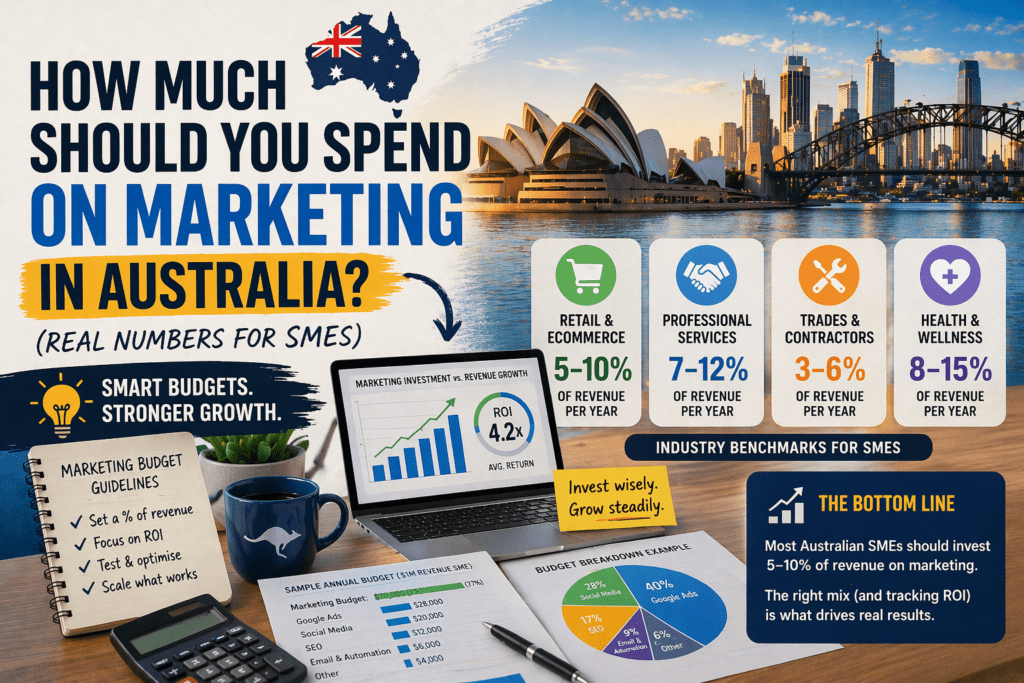
So, what are other businesses actually spending? While there’s no one-size-fits-all answer, there are some reliable benchmarks you can use as a starting point. Most small and medium-sized businesses in Australia allocate between 5% and 12% of their annual revenue to marketing. This range can vary depending on factors like growth stage, industry, and competition.
Here’s a simple breakdown:
| Business Type | Typical Marketing Spend |
| Startups | 10% – 20% of revenue |
| SMEs | 5% – 12% of revenue |
| Established | 3% – 8% of revenue |
Startups tend to spend more because they need to build awareness quickly. Established businesses, on the other hand, can rely more on brand recognition and repeat customers, allowing them to reduce their spend slightly.
Industry also plays a role. For example, e-commerce businesses often invest heavily in paid advertising Australia, while service-based businesses might focus more on SEO and local marketing. Highly competitive industries like finance, legal, and real estate typically require higher budgets to stay visible.
It’s worth noting that these are just guidelines. The right budget for your business depends on your specific goals and circumstances. But having these benchmarks gives you a solid reference point to start from.
Key Factors That Influence Marketing Budgets
When it comes to setting a marketing budget in Australia, there’s no universal number that magically works for every business. The amount you should spend depends on several moving parts, and ignoring them is where many SMEs go wrong. It’s not just about revenue—it’s about context. Your size, industry, growth goals, and even location all play a role in shaping what a “healthy” budget looks like.
One of the biggest influences is your growth ambition. Are you trying to maintain steady sales, or are you aiming to scale aggressively? Businesses in growth mode typically need to invest more heavily in digital marketing Australia, especially in areas like paid ads and lead generation. On the flip side, if you’re focused on maintaining existing customers, your budget can be leaner and more focused on retention strategies.
Another factor is your current brand awareness. If no one knows who you are, you’ll need to spend more to get noticed. But if you’ve already built a strong reputation, your marketing can shift towards nurturing and converting existing demand rather than creating it from scratch.
Cash flow also matters more than most people admit. You might want to spend 10% of your revenue on marketing, but if your margins are tight, that might not be realistic. The key is to find a balance where your investment is sustainable while still driving growth.
Business Size and Revenue
Your business size directly impacts how much you should allocate to marketing. Smaller businesses often need to spend a higher percentage of their revenue because they’re still building momentum. It’s a bit like pushing a car—getting it moving takes more effort than keeping it rolling.
For example, a business generating $200,000 annually might need to invest closer to 10–12% just to stay competitive. Meanwhile, a company making $2 million might only need to spend 5–7% because it already has systems, brand recognition, and repeat customers in place.
Here’s where it gets interesting: it’s not just about percentages—it’s about actual dollars. A 5% budget on $2 million gives you $100,000 to work with, which opens up far more opportunities than 10% of a smaller revenue base. This is why scaling businesses often see better returns—they have more room to test and optimise.
But don’t fall into the trap of thinking bigger budgets automatically mean better results. Efficiency matters just as much as size. A well-optimised $3,000 monthly budget can outperform a poorly managed $10,000 one in PPC advertising Australia.
Industry Differences in Australia
Not all industries play by the same rules, especially when it comes to marketing costs. In Australia, some sectors are significantly more competitive than others, which directly affects how much you need to spend.
Take legal services or finance, for example. The cost-per-click in Google Ads Australia for these industries can be extremely high, sometimes reaching double digits per click. That means you’ll need a larger budget just to generate a consistent flow of leads.
Compare that to a niche local service—say, a landscaping business in a regional area. The competition is lower, CPCs are cheaper, and you can often achieve solid results with a smaller budget.
E-commerce is another category entirely. Online stores often allocate a significant portion of their revenue—sometimes up to 15%—to paid social and Google Shopping campaigns. Why? Because visibility is everything in such a crowded space.
Understanding your industry benchmarks helps you set realistic expectations. It also prevents frustration when your results don’t match those of businesses operating in completely different conditions.
Real Marketing Budget Percentages for SMEs
Let’s get into the numbers that actually matter. While general benchmarks are helpful, breaking them down further gives you a clearer picture of what your SME marketing budget Australia should look like in real terms.
Startup vs Established Business Spending
Startups are in a unique position—they need visibility, and they need it fast. That’s why many Australian startups allocate anywhere from 10% to 20% of their revenue to marketing in the early stages. It might sound high, but without that investment, growth tends to stall.
Think of it like planting a garden. In the beginning, you need to water it constantly. Over time, as it grows and becomes self-sustaining, the effort (and cost) decreases.
Established businesses, on the other hand, have more flexibility. With an existing customer base and brand recognition, they can often reduce their marketing spend to around 5% to 8% of revenue. Their focus shifts from awareness to optimisation—getting more value from what they already have.
However, there’s a catch. If an established business becomes too conservative with its marketing, it risks stagnation. Competitors who continue investing will slowly take market share. So even if you’re established, cutting back too much can backfire.
B2B vs B2C Budget Allocation
Another important distinction is whether you’re operating in a B2B or B2C environment. The way you allocate your marketing budget—and how much you spend—can differ significantly.
B2C businesses typically require higher marketing spend because they’re targeting a broader audience. They often rely heavily on social media advertising, influencer marketing, and paid search to reach consumers at scale. This can push their budgets towards the higher end of the spectrum.
B2B businesses, on the other hand, usually deal with longer sales cycles and fewer but higher-value clients. Their marketing tends to focus more on content marketing, LinkedIn ads, and lead generation funnels. While their overall spend might be lower as a percentage, the cost per lead can be higher.
The key difference lies in strategy. B2C is often about volume and visibility, while B2B is about precision and relationship-building. Your budget should reflect that reality.
Where Should Your Marketing Budget Go?
Knowing how much to spend is only half the equation. The real challenge is deciding where that money should go. A poorly allocated budget can underperform even if the total spend is reasonable.
In Australia, most SMEs are shifting heavily towards digital channels—and for good reason. They offer better targeting, measurable results, and more flexibility compared to traditional advertising.
Digital Marketing Channels
Digital marketing typically takes up the largest share of an SME’s budget, often 60% to 80%. This includes everything from Google Ads and SEO to email marketing and social media.
The advantage here is control. You can track performance in real time, adjust campaigns quickly, and scale what works. This makes digital channels particularly effective for businesses looking to maximise ROI.
Google Ads and PPC Costs
Google Ads Australia is one of the fastest ways to generate leads, but it comes at a cost. Depending on your industry, you might be paying anywhere from $1 to $15+ per click.
Here’s a rough breakdown:
| Industry | Avg CPC (AUD) |
| Trades & Services | $2 – $6 |
| E-commerce | $1 – $4 |
| Legal/Finance | $8 – $20+ |
These numbers highlight why budgeting properly is so important. Without enough spend, your campaigns might not generate enough data to optimise effectively.
SEO and Content Marketing
Unlike paid ads, SEO Australia is a long-term investment. It doesn’t deliver instant results, but when done properly, it can become one of your most cost-effective channels.
Many SMEs allocate around 20% to 30% of their marketing budget to SEO and content. This includes blog writing, on-page optimisation, and link building.
The payoff? Consistent, organic traffic that doesn’t rely on ongoing ad spend. It’s like owning property instead of renting—you invest upfront, but the long-term returns are worth it.
Social Media Advertising
Social media has become a major player in the Australian digital marketing landscape. Platforms like Facebook, Instagram, and TikTok offer powerful targeting options that allow you to reach specific audiences with precision.
For many SMEs, social media accounts for 15% to 30% of the marketing budget. It’s particularly effective for B2C businesses and brands with strong visual appeal.
The key is to treat social media as more than just a promotional tool. It’s also a space for engagement, storytelling, and building relationships with your audience.
Common Budgeting Mistakes SMEs Make
Even with solid benchmarks and a decent budget, many Australian businesses still struggle to get results. Why? Because it’s not just about how much you spend—it’s about how wisely you use it. And this is where common mistakes creep in, quietly draining your marketing budget Australia without delivering much in return.
One of the biggest issues is inconsistency. Businesses often treat marketing like a tap—turning it on when they need leads and off when things get busy. The problem is, marketing doesn’t work well in bursts. It needs consistency to build momentum. Stopping and starting campaigns disrupts performance, resets learning algorithms (especially in Google Ads Australia), and ultimately makes your spend less efficient.
Another mistake is chasing trends without a clear strategy. Just because everyone is talking about TikTok ads or the latest marketing hack doesn’t mean it’s right for your business. Jumping from one tactic to another without giving anything enough time to work leads to scattered results and wasted budget.
There’s also the issue of unrealistic expectations. Some SMEs expect immediate returns from channels like SEO or brand awareness campaigns. When results don’t come quickly, they pull back spending prematurely. This short-term thinking often prevents long-term success.
Underinvesting in Marketing
Let’s be honest—this is probably the most common mistake. Many SMEs in Australia simply don’t invest enough in marketing to see meaningful results. They might allocate a small budget, run a few ads, and then conclude that digital marketing doesn’t work. But in reality, the budget was never sufficient to begin with.
Underinvesting limits your reach, reduces your ability to test different strategies, and prevents platforms like Google Ads from gathering enough data to optimise. It’s like trying to cook a proper meal with barely any ingredients—you’re not setting yourself up for success.
There’s also a psychological factor. Spending money on marketing can feel risky, especially if you’re not seeing immediate returns. But avoiding that risk often leads to stagnation. Businesses that grow are usually the ones willing to invest consistently and strategically.
That said, throwing money blindly isn’t the solution either. The goal is to invest enough to generate data, learn what works, and then scale from there. Even a modest budget can be effective if it’s used intelligently within a well-defined SME marketing strategy Australia.
Spending Without Strategy
On the flip side, some businesses spend generously—but without any real plan. This is just as problematic as underinvesting, if not worse. Without a strategy, your marketing becomes reactive rather than intentional.
You might run Google Ads, post on social media, and invest in SEO—but if these efforts aren’t aligned, they won’t reinforce each other. Instead of building momentum, you end up with disconnected activities that don’t deliver consistent results.
A good strategy ties everything together. It defines your target audience, your messaging, your channels, and your goals. It also sets clear expectations for what success looks like. Without this foundation, even a large budget can quickly disappear with little to show for it.
Think of it like building a house. You wouldn’t start laying bricks without a blueprint. Marketing works the same way—you need a plan before you start spending.
How to Calculate Your Ideal Marketing Budget
Now that we’ve covered the pitfalls, let’s get practical. How do you actually figure out the right marketing budget for your business in Australia? There are a couple of reliable methods you can use, depending on your situation.
Revenue-Based Budget Formula
The simplest approach is to base your budget on a percentage of your revenue. As mentioned earlier, most Australian SMEs fall within the 5% to 12% range. This method is straightforward and gives you a clear framework to work with.
Here’s a quick example:
- Annual revenue: $500,000
- Marketing budget (8%): $40,000 per year
- Monthly budget: ~$3,300
This approach works well because it scales with your business. As your revenue grows, your marketing budget grows with it, allowing you to expand your efforts naturally.
However, it’s not perfect. If your revenue is low, your budget might be too limited to drive growth. In that case, you may need to invest above the typical percentage temporarily to kickstart momentum.
Goal-Based Budget Planning
A more strategic approach is to base your budget on your goals rather than your revenue. This involves working backwards from your desired outcomes.
Let’s say you want to generate 50 new leads per month. If your average cost per lead in Google Ads Australia is $40, you’ll need a budget of $2,000 just for that channel. Add in other marketing activities, and your total budget starts to take shape.
This method is more precise because it ties your spending directly to results. It also helps you set realistic expectations. If your budget doesn’t align with your goals, something has to change—either your expectations or your investment.
The best approach often combines both methods. Use revenue percentages as a guideline, then refine your budget based on specific goals and performance data.
Tips to Maximise ROI on Marketing Spend
Spending money on marketing is one thing—getting a strong return is another. The difference lies in how well you optimise your efforts. With the right approach, even a modest budget can deliver impressive results in the Australian digital marketing space.
Tracking and Analytics
If you’re not tracking your results, you’re essentially guessing. And guessing is expensive. Tools like Google Analytics and conversion tracking in Google Ads allow you to see exactly what’s working and what isn’t.
Focus on metrics that matter—cost per lead, conversion rate, and return on ad spend (ROAS). These give you a clear picture of performance and help you make informed decisions.
It’s also important to review your data regularly. Trends can change quickly, and what worked last month might not work today. Staying on top of your analytics ensures you can adapt and stay competitive.
Optimising Campaign Performance
Optimisation is where the real magic happens. Small improvements—like tweaking ad copy, refining targeting, or improving landing pages—can have a significant impact on your results.
Testing is key here. Run A/B tests to compare different approaches and identify what works best. Over time, these incremental gains add up, improving your overall marketing ROI Australia.
Don’t forget about efficiency. Sometimes, the best way to improve ROI isn’t to increase revenue—it’s to reduce wasted spend. Cutting underperforming campaigns and reallocating budget to high-performing ones can make a huge difference.
Conclusion
So, how much should you spend on marketing in Australia? The honest answer is: it depends—but not in a vague, unhelpful way. With the right benchmarks, most SMEs will fall somewhere between 5% and 12% of their revenue, with higher percentages for startups and growth-focused businesses.
What really matters isn’t just the number—it’s how you use it. A well-planned, data-driven strategy will always outperform a larger budget with no direction. By understanding your business, your industry, and your goals, you can create a marketing budget that actually drives results.
FAQs
- What is the average marketing budget for SMEs in Australia?
Most SMEs spend between 5% and 12% of their annual revenue on marketing, depending on their growth stage and industry. - Should startups spend more on marketing?
Yes, startups often invest 10% to 20% of their revenue to build awareness and generate initial traction. - How should I split my marketing budget?
A common approach is 60–80% on digital marketing, with the rest allocated to branding, offline efforts, or experimentation. - Is Google Ads worth the cost in Australia?
Yes, but only when managed properly. Costs can vary widely by industry, so optimisation is key to maintaining profitability.
5. How can I improve ROI on my marketing spend?
Focus on tracking, testing, and optimisation. Use data to guide decisions and continuously refine your campaigns.